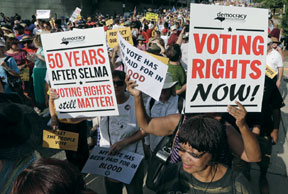
Attorneys for North Carolina NAACP, other plaintiffs undermine state’s claims
WINSTON-SALEM, N.C. – Officials for the State of North Carolina put on their final witnesses today during the third week of trial challenging H.B. 589, the state’s massive voter suppression law. As the State has attempted to defend the discriminatory measure over the past few days, attorneys representing the plaintiffs – including the North Carolina State Conference of the NAACP, the League of Women Voters of North Carolina, and the Department of Justice – revealed the flaws in their arguments, demonstrating the harmful and discriminatory impacts of the law.
Passed in 2013, H.B. 589 combines several voter suppression tactic: shortens the early voting period by a full week, eliminates same-day registration, prohibits provisional ballots cast out of precinct from being counted, expands the ability to challenge voters, and eliminates a pre-registration program for 16- and 17-year-olds, among other provisions. Plaintiffs argue the law violates Section 2 of the Voting Rights Act by disproportionately burdening voters of color. Their lawsuit is also challenging the law under the 14th and 15th Amendments of the U.S. Constitution.
This week, the State put forth its witnesses, including several experts and members of the State Board of Elections, to defend H.B. 589. Plaintiff attorneys subsequently exposed deeply flawed arguments:
- Plaintiffs rebutted testimony from Sean Trende, a com commentator, who characterized North Carolina’s law as being in the “mainstream.” By comparing the numerous measures eliminated or restricted by North Carolina’s H.B. 589 to other states with different election laws, Trende attempted to dismiss claims that the law is discriminatory.As pointed out during the cross-examination, this reasoning is wholly inappropriate: Section 2 claims depend on the specific facts and particularities of each case, and require an intensely local assessment of a voting change’s impact. In other words, what’s true for one state will not necessarily be true for any other state. In addition, there are major differences between a state that adopts and then repeals a voting practice on which African Americans disproportionately relied (as North Carolina did with H.B. 589), and a state that never adopted the practice in the first place.
- Plaintiffs challenged the assertion by M.V. “Trey” Hood, a professor of political science at the University of Georgia, who argued that H.B. 589 could not have had a disproportionate impact because African-American participation increased in 2014 compared to the 2010 election. Turnout figures alone do not tell the story of burden placed on voters of color. If African Americans and Latinos had to overcome greater burdens to exercise their right to vote, that is in violation of Section 2.Plaintiffs’ counsel similarly demonstrated that testimony by economist Janet Thornton, also pointing to African-American voter increase in 2014, failed to account for numerous factors including the competitiveness of the races, socio-economic factors, and the unprecedented voter mobilization efforts that emerged in the face of community outrage after the law was passed. Ignoring these factors tells an incomplete story.
- Kim Strach, director of the North Carolina State Board of Elections, took the stand Wednesday to emphasize there are other ways to register besides same-day registration, which was eliminated by H.B. 589. Voters may still register, she contended, at DMV offices local libraries, public assistance agencies, high schools and colleges within 25 days of an election.
- This erroneously implies that, as long as there is some possible way to register, then North Carolina is not in violation of Section 2. By this logic, a poll tax would be permissible because voters could feasibly save up the money needed to pay it. Strach’s argument also fails to account for the steep drop in voter registrations from North Carolina public assistance agencies.
- Brian Neesby, an analyst with the State Board of Elections, attempted to explain the State Board of Election’s prior findings that same-day registrations are more secure, verifying at a higher rate than other registration methods. Neesby tried to counter his own agency’s data by offering new calculations, in a different report, made in response to the lawsuit.
Following rebuttal testimony from plaintiffs, this afternoon the court will hear closing arguments from both sides.
Advancement Project is a multi-racial civil rights organization. Founded by a team of veteran civil rights lawyers in 1999, Advancement Project was created to develop and inspire community-based solutions based on the same high quality legal analysis and public education campaigns that produced the landmark civil rights victories of earlier eras.