
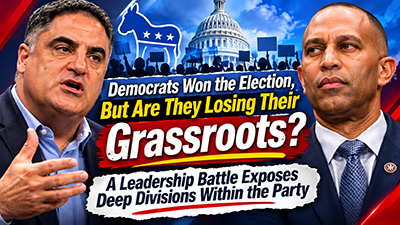
Progressive commentator Cenk Uygur’s criticism of Hakeem Jeffries raises a larger question: Will the Democratic Party listen to the people who helped deliver its victories, or continue with politics as usual?
By Westside Gazette Staff | Political Analysis
WASHINGTON, D.C. — The Democratic Party emerged from the 2026 midterm elections with a commanding congressional victory, but a growing conflict within its own ranks is raising questions about the party’s leadership, its relationship with grassroots voters, and whether the people who helped bring Democrats to power will have a meaningful voice in determining its direction.
At the center of the controversy is House Democratic Leader Hakeem Jeffries, whose leadership is facing criticism from progressive activists and political commentators, including Cenk Uygur, co-founder of the progressive news program The Young Turks.
Uygur recently described Jeffries as an “incompetent leader” following a failed effort to advance impeachment proceedings against Defense Secretary Pete Hegseth.
The House voted 211–204 to refer the impeachment resolution to committee, effectively stalling the effort. Eleven Democrats missed the vote, and their absence immediately triggered criticism about party discipline and accountability.
Uygur argued that Jeffries had failed to provide effective leadership. He also alleged that pro-Israel lobbying interests influenced the outcome, although that accusation has not been substantiated. Several absent Democratic lawmakers said traffic delays prevented them from reaching the House chamber before voting ended. Daily Wire +2
But the controversy extends far beyond a single congressional vote.
A Victory at the Ballot Box, a Struggle Within the Party
The November elections delivered significant victories for Democrats, providing the party with a renewed opportunity to influence the nation’s legislative agenda.
Yet the results have also intensified disagreements over who should lead the party and what priorities that leadership should pursue.
According to reporting by The Washington Post and Axios, progressive organizations and voters have mounted campaigns questioning whether Jeffries and Senate Democratic Leader Chuck Schumer should continue leading their respective chambers.
Some Democratic congressional offices have reported receiving hundreds of calls demanding leadership changes.
Critics argue that the party needs leaders who are more willing to challenge corporate influence, address economic inequality, confront the Trump administration, and respond directly to grassroots concerns.
Jeffries’ supporters, however, point to his ability to maintain party unity and help Democrats secure substantial electoral gains. Michigan Congresswoman Debbie Dingell publicly defended his leadership, saying he had earned the right to continue leading House Democrats. The Washington Post +1
The competing arguments expose a fundamental question: Does winning an election automatically validate a party’s leadership, or should electoral success create an opportunity to reconsider who holds power?
The Grassroots Movement Wants More Than Campaign Promises
For many grassroots activists, the frustration is not simply about personalities.
It is about political influence, financial support, and whether the Democratic Party’s priorities reflect the needs of working-class Americans.
Across the country, progressive candidates have built campaigns around affordable healthcare, higher wages, stronger public education, economic opportunity, and reducing the influence of wealthy political donors.
Yet those campaigns have sometimes encountered resistance from within their own party.
The November election in Michigan provided one particularly striking example.
Democratic Congresswoman Haley Stevens endorsed Republican Mike Rogers in the U.S. Senate race rather than supporting Democratic nominee Abdul El-Sayed, who had defeated her in the Democratic primary.
Their dispute involved sharply different positions on Israel and the war in Gaza. Stevens accused an advertisement by a group supporting El-Sayed of antisemitism, while progressive organizations condemned her decision to support a Republican.
The controversy demonstrated how disagreements over foreign policy and ideological direction can fracture party unity even during a major election. Al Jazeera
What Does This Mean for Black Political Power?
For Black voters, particularly those in communities where the Democratic Party has historically enjoyed strong support, the leadership debate raises another set of questions.
Black voters have played important roles in Democratic electoral coalitions for generations. Their participation has helped shape local, state, and national elections.
But political participation and political influence are not necessarily the same thing.
When Black communities provide votes, organize neighborhoods, register new voters, and mobilize turnout, what level of influence should they expect in return?
Are candidates emerging from grassroots organizations receiving meaningful institutional support?
Are Black-owned businesses, community newspapers, historically Black colleges and universities, and neighborhood organizations included in the party’s economic and policy priorities?
And when grassroots candidates challenge established political interests, does the party welcome that competition or seek to preserve its existing leadership structure?
These questions deserve serious consideration regardless of which faction ultimately controls the Democratic Party.
Florida’s Angie Nixon Campaign Adds Another Dimension
The 2026 Florida U.S. Senate campaign of Angie Nixon provides another opportunity to examine the relationship between grassroots politics and institutional Democratic support.
Nixon’s campaign emphasized issues affecting working families, including healthcare affordability, wages, education, and economic opportunity.
Following her defeat, questions have emerged about campaign financing, statewide messaging, demographic outreach, and the level of support provided by national and state Democratic organizations.
Whether insufficient institutional support materially contributed to Nixon’s defeat remains a question requiring campaign financial records, interviews, and voter data.
However, her campaign illustrates a larger issue: Can a grassroots candidate successfully build statewide political power without substantial financial backing from the party’s established fundraising networks?
The answer could have implications far beyond Florida.
For candidates representing communities that have historically been excluded from political and economic power, access to campaign resources can be just as consequential as public enthusiasm.
Is the Democratic Party Afraid of Its Own Grassroots?
The question is provocative, but the evidence requires careful examination.
Progressive activists argue that party leaders sometimes resist movements that threaten existing relationships with donors, political consultants, and established elected officials.
Party leaders and their supporters counter that winning elections requires building broad coalitions, managing competing interests, and supporting candidates capable of appealing to diverse constituencies.
Both positions deserve scrutiny.
What cannot be ignored is the growing public pressure for greater transparency and accountability.
The leadership challenges facing Jeffries and Schumer are not merely disagreements between politicians. They reflect competing visions of what the Democratic Party should become after its electoral victories.
A Moment of Decision
The Democratic Party now faces an important test.
Having regained congressional power, its leaders must determine how to translate electoral success into effective governance while responding to demands for change from within their own political coalition.
The dispute surrounding Hakeem Jeffries may eventually fade, but the underlying questions will remain.
Who controls the party’s agenda?
Who decides which candidates receive financial support?
Who benefits from political victories?
And perhaps most importantly, will the grassroots voters who helped deliver those victories have a meaningful voice after Election Day?
For Black communities and other historically underrepresented constituencies, those are not abstract political questions. They are questions about representation, opportunity, accountability, and the future distribution of political power.
The Democratic Party has won an important election.
Whether it can unite its competing factions, strengthen public confidence, and turn that victory into meaningful change is the challenge that now lies ahead.
Suggested pull quote for the Westside Gazette:
“Winning an election gives a political party power. Listening to the people who made that victory possible determines how that power is used.”
Reporting sources: The Washington Post, November 10, 2026; Axios, November 6, 2026; Al Jazeera, November 1, 2026; reporting on the November 10 House impeachment vote.