
Her home deserves preservation, not another flip
(Source: The MiamiTimes)
By Daniella Pierre
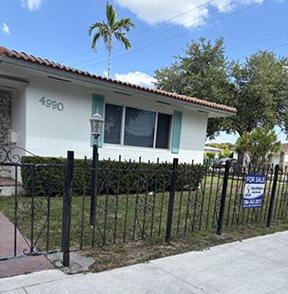
Dr. Enid C. Pinkney understood that when a community loses its history, it risks losing its identity. She devoted her life to ensuring that Miami’s Black community would be recognized, remembered and preserved. Today, her own home stands at a crossroads, forcing us to ask whether we will honor that legacy or allow another piece of our history to quietly disappear.
Just a few weeks ago, while visiting Jefferson Reaves Sr. Park, I noticed something that stopped me in my tracks. Hanging from the front gate of Dr. Pinkney’s home was a simple sign: For Sale.
I was shocked. Then I was saddened.
After gathering myself, I called the number on the sign to inquire about the property. I learned that the home had recently changed hands after being purchased in March and is now back on the market with an asking price of $700,000. It appears poised to become another investment property, another flip, another chapter in the ongoing transformation of historically Black neighborhoods.
But this is not just another house.
This was the home of our beloved Dr. Enid C. Pinkney, a history-maker whose life’s work was dedicated to ensuring that Black history in Miami would never be erased. She was more than a historian. She was a preservationist, educator, author and relentless advocate for preserving the places and stories that define who we are.
Dr. Pinkney understood something many of us are only beginning to appreciate: preserving history is not simply about saving old buildings. It is about protecting the identity, culture and collective memory of a people.
She led the effort to save the Historic Hampton House from demolition, helping transform it into one of South Florida’s most important civil rights landmarks. Dr. Pinkney was also instrumental in preserving Georgette’s Tea Room. As the first Black president of Dade Heritage Trust, she expanded preservation efforts to include places that reflected the experiences and contributions of Black Miami. She documented the history of Brownsville through books, documentaries and oral histories, ensuring that future generations would know the stories that too often go untold. She also played a critical role in preventing Brownsville from being annexed by Hialeah because she understood that preserving a community meant protecting both its people and its story.
What is happening to Dr. Pinkney’s former home stands in stark contrast to everything she spent decades fighting for.
If any home deserves serious consideration for historic designation and preservation, it is the home of the woman who dedicated her life to preserving everyone else’s history. Historic preservation guidelines recognize properties associated with individuals whose contributions have significantly shaped our history, provided those properties retain their historic integrity. Dr. Pinkney’s home deserves that conversation, and our community deserves the opportunity to have it before another opportunity is lost.
But this conversation cannot stop with one house.
Dr. Pinkney’s home should be our wake-up and clarion call.
Across Miami-Dade County, pieces of Black history continue to disappear. Historic homes are demolished. Neighborhood landmarks are redeveloped. Churches, schools, businesses and gathering spaces that once served as pillars of our community slowly fade away, often before anyone pauses to ask what they meant or what will replace them.
We cannot continue reacting after the “For Sale” sign goes up.
We need a real-time inventory of our historically significant Black places and spaces in our community. We need stronger partnerships between preservation organizations, local government, community leaders, universities and philanthropists. We need to identify culturally significant properties before they are sold, redeveloped or demolished. Most importantly, we need to decide whether preserving Black history is a community priority or simply something we celebrate once it is gone.
Imagine a different future.
Imagine this home becoming the Dr. Enid C. Pinkney House, serving as a museum, educational center, research archive and collaborative gathering place where students, historians, neighborhood organizations, preservationists and community leaders could learn from the woman who spent her life teaching others that our history matters. Imagine young people walking through those doors and realizing that history survives only because ordinary people choose to protect it.
The question before us is much larger than one address.
What other homes, churches, schools, businesses and gathering places are quietly disappearing before we recognize their significance? What stories will future generations never know because we failed to preserve the places where they happened? Perhaps Dr. Pinkney’s home is not only an opportunity to preserve one remarkable legacy, but also a chance to reexamine how Miami-Dade protects the places that define our shared history.
Dr. Enid C. Pinkney spent her life fighting to save our history.
Now, history is asking whether we are willing to save hers.
Daniella Pierre is a community advocate and president of the Miami-Dade County Branch of the NAACP, where she has served as an active member since 2011.