
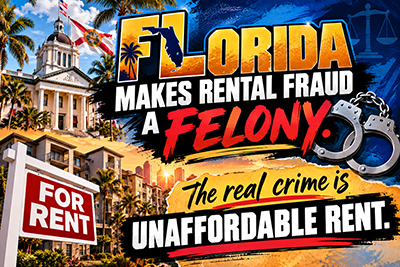
Florida wants renters to tell the truth on their applications.
By Daniella Pierre, Miami Times Columnist
(Source: Miami Times)
Fair enough.
Now let’s tell the truth about what it takes to get approved for a residential unit here in Florida.
First came the hurdles.
Prove you earn three times the rent in one month. Pay the application fee. The administrative fee. Get a guarantor or two. The holding fee. Some fees may be non-refundable.
Everybody wants a payment before you even get a key.
Then came the squeeze. People in our communities found themselves priced out of living here.
And for those stuck in the middle? Earn just a little over a housing program’s income limit, often based on Area Median Income, and you may not qualify for help or the residential unit. Still cannot afford rent? That becomes your problem to figure out.
Too much income for assistance. Too little income for approval.
Welcome to the unaffordable State of Florida.
Now comes another consequence: a third-degree felony.
Yep, you heard that right.
Starting October 1, 2026, HB 1293 makes knowingly and willfully using certain fraud, including fake pay stubs or fake bank statements, to enter and take possession of a residential rental a third-degree felony.
Let me be clear. I do not condone, support or subscribe to fraud. Finding a way to stay housed does not give anyone permission to falsify documents.
Protecting landlords from fraud is a legitimate goal. However, families deserve that same urgency for the barriers they face.
I refuse to discuss fake paychecks without discussing why the real paychecks will not qualify.
If an apartment rents for $2,000 and the landlord requires income of three times the rent, you must prove you earn $6,000 in one month just to qualify. And that’s just for a one-bedroom apartment. That is $72,000 a year.
The rent is $2,000. The income requirement is $6,000. And the fees, sometimes including trash removal and parking, are extra.
Where is the job with the paycheck that makes all of this work?
That income requirement comes from the landlord, not HB 1293. But it is part of the barrier lawmakers need to address.
To me, the real crime is a moral failure: demanding proof of income that working people’s jobs do not pay, piling on fees, and making punishment way more urgent than a pathway to housing.
An honest paycheck should give people a fighting chance when searching for a place to live.
Where is the law that helps make that happen?
Oh, wait. Florida blocked cities and counties from adopting rent control. State lawmakers hold the power to change that. They didn’t pass it this year. Let’s see what happens next year.
Policymakers must enact rent control with protections that keep housing available and maintained. They must limit excessive rental fees, preserve affordable homes and expand assistance for the missing middle.
Employers must pay a living wage. If your business depends on people showing up, their wages should help them afford a place to go home to.
Residents should organize and work with attorneys to explore legal challenges where valid grounds may exist concerning HB 1293. Push for change in court, at public meetings and at the ballot box.
Landlords should consider a uniformed verified rental payment history instead of letting one income formula tell a person’s whole story.
Finding a place to live in Florida should not require a financial miracle.
HB 1293 does not lower rent, increase pay or build a home. Preventing fraud matters. Making the honest path possible deserves action, too.
Instead, another penalty arrives while the rent remains out of reach.
I do not support fake documents. I support real affordable housing solutions.
Lawmakers, bring that same energy and urgency to making Florida affordable.
Florida found the votes to update the rules on rental fraud. Now find the votes for rent control. Because adopting HB 1293 without rent control is unfair.