
By Westside Gazette Staff
FORT LAUDERDALE, FL — Florida’s 2026 general election has brought millions of voters into the political process, with consequential contests for governor, the United States Senate, Congress and local offices determining the direction of government for years to come.
As of November 2, more than 5.4 million Floridians had cast ballots through early in-person voting and vote-by-mail. That represented approximately 39.5% of registered voters before Election Day participation was included.
The early vote consisted of approximately 3.46 million in-person ballots and 1.94 million mail ballots, demonstrating substantial participation in an election shaped by debates over affordability, education, health care, immigration, and political representation.
For Florida’s Black communities, particularly in Broward, Miami-Dade and Palm Beach counties, the election has raised questions about representation and whether elected officials will address the economic and social concerns of historically underserved neighborhoods.
Broward County Turnout Tells an Important Story
Broward County, one of Florida’s largest Democratic strongholds, recorded significant voter participation.
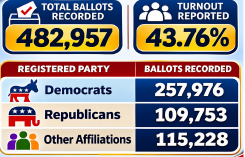
According to figures compiled from the Broward County Supervisor of Elections and displayed by FreshTake.Vote, approximately 482,957 ballots had been recorded in the county in an Election Day morning update, representing 43.76% of its 1.1 million registered voters.
Broward County turnout snapshot:
Turnout reported
43.76%
Registered party
Ballots recorded
Democrats
257,976
Republicans
109,753
Other affiliations
115,228
Preliminary November 3 morning figures, not final Election Day totals. Party affiliation does not establish which candidate received a voter’s ballot. Tracking Voter Turnout in Florida
These figures show Democratic-registered voters participating at a higher rate than Republican-registered voters in Broward, although the numbers do not establish how those voters selected candidates in individual races.
Governor’s Race Places Florida’s Direction in Focus
The gubernatorial contest between Republican Congressman Byron Donalds and Democrat David Jolly has been among Florida’s most closely watched political battles.
Donalds, backed by President Donald Trump, has campaigned on conservative priorities and continuing Republican leadership in Tallahassee. Jolly, a former Republican congressman, has emphasized affordability, education and a different approach to state government.
The election also carries historical significance. A victory by Donalds would make him Florida’s first Black governor.
For voters, however, the election involves more than history. The next administration will influence decisions affecting homeowners’ insurance, housing costs, public education, employment opportunities and state spending.
Angie Nixon and Ashley Moody Compete for U.S. Senate
Florida’s U.S. Senate contest between Democrat Angie Nixon and Republican incumbent Ashley Moody has generated substantial attention.
Nixon, a state representative from Jacksonville, has focused her campaign on working families, health care, wages and public education. Moody, appointed to the Senate in 2025, has emphasized her record in public office and conservative policy positions.
Final pre-election polling reported by Action Network showed Moody leading Nixon by margins ranging from two to seven percentage points across the surveys it reviewed. These were polling estimates, not election results, and individual surveys differed in methodology and timing. Action Network
The election will determine who completes the remainder of the Senate term formerly held by Marco Rubio.
Congressional Elections Could Reshape Representation
Florida’s congressional contests have also drawn attention following changes to district boundaries.
In South Florida, the election includes contests affecting communities throughout Broward, Miami-Dade and Palm Beach counties.
Florida’s 24th Congressional District features Democrat Oliver Gilbert III and Republican T.E. Brown in the contest for the seat previously held by longtime Congresswoman Frederica Wilson.
Elsewhere, candidates are competing over issues ranging from federal spending and immigration to education and health care.
For Black communities, the composition of Florida’s congressional delegation will affect representation in federal policy discussions and decisions involving community investment. wplg +1
Election Administration Faces Challenges
The election also brought renewed attention to voting-system reliability and the impact of severe weather.
In Broward County, a temporary technical problem affected voting operations at multiple polling locations. Election officials reported that the problem was corrected after approximately 10 to 15 minutes.
Severe flooding also forced the relocation of a Davie polling precinct.
Although officials reported that the technical issue was resolved, the incidents highlighted the importance of reliable election systems and clear communication when unexpected problems occur. Fort Lauderdale
The Numbers Behind the Election
Florida’s reported early participation
The numbers demonstrate substantial participation across Florida. However, turnout alone cannot establish the outcome of the election, particularly in a state where registration advantages, independent voters and regional voting patterns vary considerably.
The final results will provide a clearer picture of how voters responded to the candidates and issues presented during the campaign.
Beyond Election Day: The Responsibility of Representation
The election may determine who occupies the offices, but the decisions made by those officials will determine how their leadership affects Florida residents.
Questions surrounding public education, affordable housing, economic opportunity, health care, neighborhood investment and political representation will remain after the ballots are counted.
For communities that have fought generations for equal access to the political process, the significance of an election extends beyond the names appearing on a ballot.
The next chapter will be written through public policy, government accountability and the willingness of elected officials to respond to the people they represent.
The election determines who holds the power. What those officials do with that power will determine its impact on the people of Florida.
Publication verification note
The updated figures above are the latest verified numbers I could retrieve, but they are not final election returns. The state results source had not yet posted candidate vote totals at the time of checking. Because this edition will appear after the election, the final governor, Senate and congressional results should be inserted before the paper goes to press.
The official source for those figures is Florida Election Watch.