

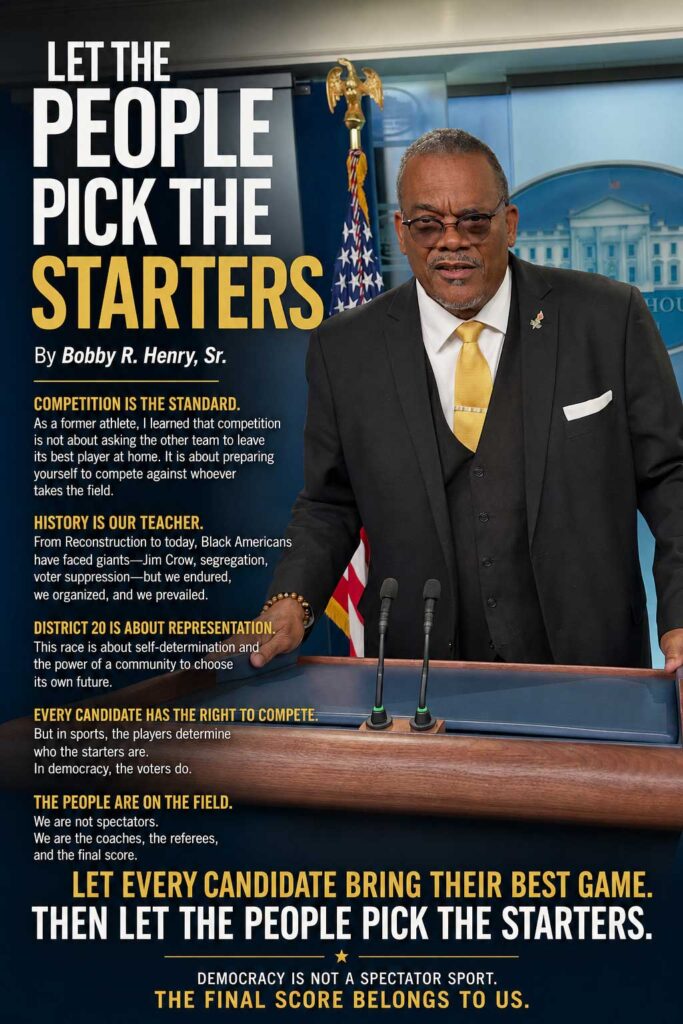
By Bobby R. Henry, Sr.
As a former athlete, I learned that competition is not about asking the other team to leave its best player at home. It is about preparing yourself to compete against whoever takes the field.
You never ask the opposing coach to bench their star player. You don’t complain because the other team has a larger budget, a stronger reputation, or a player who seems impossible to beat. You prepare. You practice. You trust your training. Then you step onto the field and let the game be decided.
Sometimes the other team even has a “ringer”—that special player who appears to have every advantage. In biblical terms, a Goliath.
But history teaches us that giants are not undefeated.
Black Americans know this story well because we have lived it.
Following Reconstruction, Black citizens briefly experienced the promise of full participation in American democracy. Black men voted, held office, and helped shape the future of their communities. But that progress was met with fierce resistance. Jim Crow laws, poll taxes, literacy tests, intimidation, and violence were designed to silence Black voices and strip away political power.
Yet we endured.
When the odds were stacked against us, we organized. When doors were closed, we built our own institutions. When our voices were ignored, we created newspapers, churches, civic organizations, and movements that demanded to be heard.
When the struggle for voting rights reached its peak, ordinary men and women marched across bridges, faced attack dogs, endured jail cells, and in some cases gave their lives so future generations could cast a ballot freely.
The Voting Rights Act of 1965 became one of the greatest victories of the Civil Rights Movement. Yet even today, many believe those protections have been weakened and continue to face challenges. The struggle for political representation did not end in 1965. It simply entered a new chapter.
That is why the conversation surrounding Congressional District 20 is so important.
This race is about more than personalities, endorsements, or campaign advertisements. It is about the fundamental question of who will represent the voices and interests of the people who call this district home.
Like every competition, there are talented players on the field. Some have greater name recognition. Some have more resources. Some have larger political networks. Every candidate has the right to compete.
But in sports, the players determine who the starters are. Starting positions are earned through preparation, performance, discipline, and practical experience. The same principle should apply in public service.
Candidates must earn the confidence of the voters.
And voters must do their part.
The field is set. The game has begun. The question is not whether a particular player should be removed from the field. The question is whether the people will show up and decide who deserves to start.
Against all odds, Black voters have always prevailed when we participated.
We prevailed during Reconstruction.
We prevailed through Jim Crow.
We prevailed through segregation.
We prevailed through the Civil Rights Movement.
And we can prevail today.
The ballot box remains the great equalizer. No amount of money, influence, endorsements, or political power can overcome a community that is informed, engaged, and determined to exercise its right to vote.
So let every candidate bring their best game.
Let every campaign make its case.
Let every voter study the record, examine the experience, and consider the vision each candidate offers.
Then let the people pick the starters.
And when Election Day arrives, let there be no doubt that the outcome was determined not by fear, not by political insiders, and not by circumstance—but by the will of the voters.
Because democracy is not a spectator sport.
The people are not sitting in the stands.
We are all on the field together and the final score belongs to us.