
By Lisa Peet
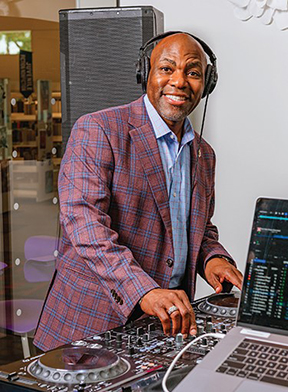
For his work bringing partners from across the county to drive innovation and change lives, Las Vegas–Clark County Library District Executive Director Kelvin Watson is LJ’s 2026 Librarian of the Year.
When Kelvin Watson arrived in his new role as executive director of the Las Vegas–Clark County Library District (LVCCLD) in spring 2021, services were opening up again after COVID-19 shutdowns. His first challenges, he says, involved getting people back into the library and building relationships outside it, as well as helping craft a new strategic plan.
Watson was also the first full-time African American library director in the state, and some people needed time to adjust to that, he says. “The first six months for me were all of those things happening—figuring out who’s who and what’s what in the community, building relationships, getting people to trust me.”
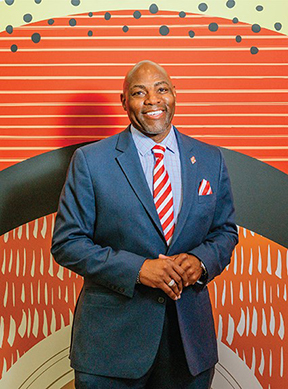
Within a few weeks of his arrival, he had met the heads of the Las Vegas Global Economic Alliance and Chamber of Commerce, the Clark County Schools Superintendent, and the presidents of area universities. “I was out every day, doing library things and community things, attending galas, attending fundraising events, and just getting my face out there, talking about the library,” he says. “I think I’ve been to every Rotary Club meeting.”
The results have been unquestionable. LVCCLD has received the American Library Association (ALA)/Information Today Library of the Future Award three years running; the 2023 ALA Medal of Excellence Award; and the 2023 Urban Libraries Council Innovation Award for Anti-Racism, Digital Equity & Inclusion, among many other accolades. Programming and circulation metrics have surpassed those of 2019.
“Kelvin came here and he hit the ground running in terms of getting involved, getting to know all the players,” says Keith Rogers, chair of the LVCCLD Board of Trustees. “Kelvin is still everywhere. He’s on the news outlets doing interviews, he’s at all the conferences, serving as a panelist, a guest speaker, he’s mentoring other young librarians. He’s everywhere, and that’s a big part—having the energy to be able to execute your ambitious vision for this work.”
That energy, imagination, and the determination to reach people where they are to help address inequities has earned Watson LJ’s 2026 Librarian of the Year award, sponsored by OCLC.
EARLY INNOVATION
Watson eased into the library world gradually. After earning a degree in Business Administration with a minor in Military Science, and time in the Army, he arrived at Ingram Library Services. Becoming a librarian wasn’t on his radar, but his role brought him into conversation with customers. In 1999, he attended the Black Caucus of the American Library Association’s (BCALA) National Conference of African American Librarians in his future home of Las Vegas and was impressed by the library leaders he met.
From there, Watson moved on to Borders Group and then The Library Corporation. With the encouragement of colleagues and mentors, he received Spectrum Scholarships from the American Library Association (ALA), Reference and User Services Association (RUSA), and American Association of School Librarians (AASL), and was an Association of Research Libraries Diversity Participant Scholar—casting a wide net, since “I didn’t know what kind of librarian I wanted to be,” he says.
Initial indecision aside, Watson’s career proceeded quickly. After serving as head of collections and chief collection development officer at the National Agriculture Library just outside of Washington, DC, he decided he wanted to be in public libraries and applied for the role of director at the Queens Public Library (QPL), NY, Central Library.
He didn’t get the job. But he had applied for a second role, as Director of Electronic Content Services and Strategy, and then–EVP Bridget Quinn asked him interview again. It was 2012, and there was no official description for the position, so Watson and Quinn, along with former Director Thomas Galante, wrote up a job outline on the spot. “That role,” says Watson, “was the projectile for me.”
Watson read his first library ebook the weekend before he started. Drawing from his time at Ingram and Borders, he looked at the experience from a user perspective. “Okay,” he thought, “now I know what we’re trying to solve”—starting with the 14 steps it took to download an ebook.
The next innovation prompt was more urgent. Hurricane Sandy hit the northeast that October, taking out power in much of the New York metro area for over a week. In the aftermath, Google gave 5,000 Nexus 7 tablets to QPL as part of a larger citywide donation. However, the tablets came without any preloaded content and required Wi-Fi for full functionality—a barrier in that area even before Sandy.
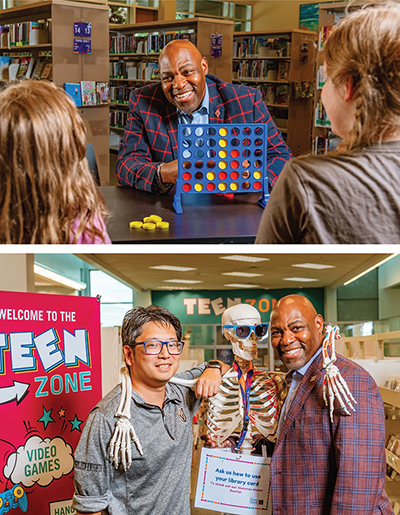
This was an opportunity for QPL to create a simple, customized tablet interface using existing library content, Watson suggested, which could be used with or without Wi-Fi, and would come loaded with curated information on library programs and services as well as OverDrive, Blio, and Acoustik apps, enabling patrons to check out ebooks and digital audiobooks, plus Zinio and Freegal to download magazines and music. Any updates would be applied when users were within range of library Wi-Fi.
QPL began lending the tablets in November 2013 at seven locations and the pilot proved successful. More tablets were rolled out the following spring at all QPL branches. The program received an ALA Library of the Future award, among others, and was recognized by Urban Libraries Council’s Innovations Initiative.
Watson continued to rise through the ranks, eventually becoming Chief Operating Officer and Senior VP. Among other initiatives begun under his watch, QPL partnered with NYC Health + Hospitals/Elmhurst, a local hospital, to deliver thousands of popular magazines to personal devices such as smartphones, tablets, and laptops for free. But, says Watson, he “was getting the bug to be a library director.”
TESTING GROUND
In his next role, as Director of Broward County Library (BCL), FL, Watson’s successes at QPL served as both inspiration and blueprints for a new round of innovations. He repurposed the tablet app and hospital access projects on a larger scale: digital services from buses, parks, DMV offices, and fitness centers—and the award-winning FLLibrary partnership with the Fort Lauderdale Airport, which provided a QR code throughout the airport that let travelers download library materials, music, and movies on their devices (Broward became the testing ground for projects with origins in Queens, but that scaled up as technology and tools became increasingly accessible. “We would do things in Broward like, ‘Okay, we don’t have enough hotspots [for everyone], but we’re going to do a veterans-only project where we’re going to allow veterans and active-duty members and their families to borrow materials,’” says Watson. “Again, repackaging and rethinking things.” Under his leadership, the Florida Library Association named BCL its 2020 Library of the Year and Watson 2019 Librarian of the Year, and ALA named Broward the Library of the Future.
After four years, Watson was ready for bigger game. Clark County, in southern Nevada, is larger than the state of New Jersey, encompassing more than 8,000 square miles to the north and south of Las Vegas. “I came to Vegas because I saw opportunity,” he says. “Las Vegas was like a sleeping giant, a big library system that covered a lot of area, with a significant budget.” But there wasn’t enough of a spotlight on the system locally or nationally, given its potential, he thought.
“I felt like what we had done in Queens, and what we had in Broward, could be duplicated,” he says. “During my interview process, I talked about all the things that we could do.” The Executive Committee was impressed—not only by Watson’s ideas, but how he presented them, answering complex questions about his experience and goals with specific and substantive examples. “When you’re in leadership position, sometimes you are far removed from a lot of the details,” says Rogers. “But he was able to provide really detailed answers about what he was doing in his previous post, and how he would be able to do similar things in this position, and that he was a hands-on leader.”
CHANGING LIVES
Watson didn’t waste any time once he arrived at LVCCLD, starting with the Anywhere Library, a partnership with the Regional Transportation Commission (RTC) of Southern Nevada. In the spirit of Broward’s Pop-Up Libraries, this version provided access to free movies, ebooks, audiobooks, and magazines from the library’s digital collection on 400 Wi-Fi enabled buses via OverDrive’s Libby app. Since 2022, the program has kept commuters engaged while introducing the library to thousands of potential new customers.
That early success was followed by LVCCLD’s Cell Phone Lending Program, which began with a call from the Nevada State Librarian, who had federal funding earmarked for broadband services available—but it couldn’t be used for hotspot lending or tablets. Watson reached out to a former Broward County partner at T-Mobile and confirmed that there was a cell phone program that fit the bill.
The library had funds to buy 400 smartphones and pay for 18 months of service—extended to 24 months with the help of an ALA grant. “We preloaded the devices with county resources—shelter, food, clothing,” says Watson. LVCCLD distributed the phones to low-income and unhoused residents, enabling them to access critical services and stay in touch with family and friends, medical providers, and housing providers.
“I got the call in December, we launched it in April,” says Watson. “We changed people’s lives.”
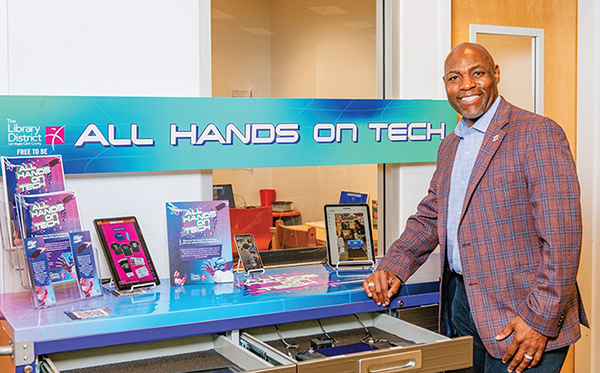
In 2024, LVCCLD received the Library of the Future Award for a trio of “Free to Be Connected” programs supporting underserved communities, including Book Vending Machines at the Sunrise Children’s Hospital and the Boulevard Mall, where cardholders can check out books; and the Hope for Prisoners Family Libraries, located in the Hope for Prisoners HQ and the Casa Grande Transitional Housing Center, for which the library provides donated laptops, books, and digital resources to connect users with library services, social services, and other resources to help them during reentry.
The third, Free Cox WiFi Hotspot Access—funded through the federal Emergency Connectivity Fund as part of the American Rescue Plan and a partnership with Cox Communications—provides free high-speed broadband and Wi-Fi to low-income households on up to three devices.
After eight months, the program had connected nearly 20,000 residents, who used the hotspot access to land jobs, secure housing, or keep medical appointments. This year, Cox Communications will be partnering with the library and United Healthcare to provide telehealth and information services to Medicaid patients. Connectivity “is the great equalizer,” says Janet Uthman, market leader and vice president of Cox Las Vegas. “It is a life changer, and [Watson] gets that. He got it from day one.”
BRINGING A CROWD
A critical component of Watson’s ability to make large projects happen quickly is his talent for building and maintaining relationships—and he wasted no time forging new connections the moment he landed in Las Vegas.
One of his first actions was to join Workforce Connections, the Local Workforce Development Board for Southern Nevada, which oversees the local network of American Job Centers. “Six hours into my first day here in Vegas,
I was at a Workforce Connections event where I had an opportunity to meet the executive director,” along with Nevada Sen. Catherine Cortez Masto, Watson says. The head of the RTC sat on the Workforce Connections board with Watson, paving the way for the Anywhere Library project.
Watson can be found at Las Vegas Executives Association breakfasts, NAACP luncheons, and NFL Foundation events, talking about the library. The NFL Foundation, working with LVCCLD, Barbershop Books, and Microsoft, donated funds to place books in 10 local barbershops for kids and their families to read while waiting for haircuts—also recruiting barbers to encourage young visitors to read. As the number of participating locations has increased, the library has created literacy kits to give away to families.
When Cox’s Uthman started out in Las Vegas, Watson was one of the first community members she met; he offered to help her with anything she needed. She noted how connected he was, and at the first event they partnered on, he brought a host of political and business influencers to learn about Cox’s digital equity work. At that time, Watson had been in Las Vegas barely a year. “He can bring a crowd. The Attorney General of Nevada was there with his wife. He had presidents of local universities in attendance,” recalls Uthman. “He brought the A-List to this event, the key people that we needed to spread awareness.”
A NEW WEST LAS VEGAS BRANCH
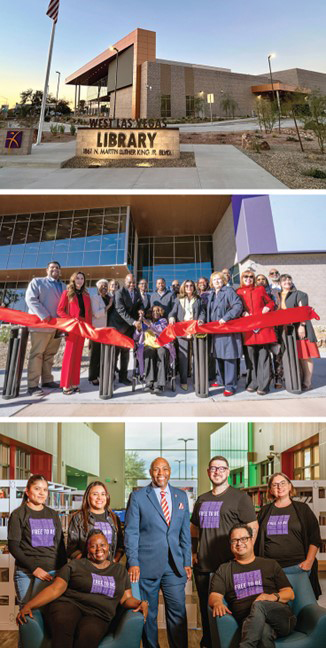
Since arriving in Vegas, Watson had his eye on updating the West Las Vegas Library, a small and under-resourced branch that serves a historically Black community. Residents were concerned, at first, about replacing the old and well-loved library, but once he had assuaged their fears through conversations and listening sessions, enthusiasm for the project grew. The city donated five and a quarter acres for a new facility. The $40 million, 41,000 square foot West Las Vegas Library opened in December 2025, featuring a large meeting space, commercial kitchen, DJ and podcasting studios, a recording studio, digital preservation lab, tween space dedicated to the Tuskegee Airmen, outdoor gathering areas, ample parking spaces, and more. A range of work is already planned with its neighbor, the West Las Vegas Arts Center.
“His vision for that library was to bring in community partners,” says Uthman. “I tell him it’s going to be a game changer, because they see that gorgeous structure, and other developers are going to want to come into this community. It can change the whole trajectory of this side of town, and we’re going to bring much-needed services.”
“This is probably going to be one of the baddest public libraries on the West Coast, if not the United States,” says Rogers, who represents the branch’s Ward Five neighborhood on the board. “It’s going to get lots of awards.”
MENTORSHIP AND SECRET SAUCE
Watson’s leadership style isn’t only about the connections he makes; he encourages employees throughout the library to build partnerships. “Branch managers will establish relationships around their local community—that then flows up and down the organization,” he says. “That’s why our partnerships, I believe, are so strong here. It’s not on one person or one department. It’s in the organization’s DNA.”
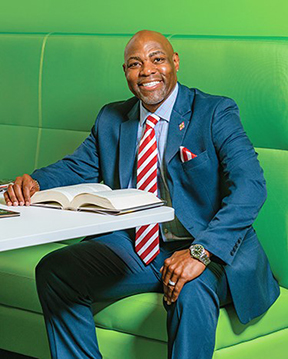
Watson has had many mentors throughout his life who helped keep him on track and inspired him, starting with his great uncle, whom he followed into the military, and a long list of library notables. “So how do I pay it forward?” he muses. “My goal is to help people the best that I can, however I can,” whether that’s career advice, a supportive phone call, or modeling good leadership.
Billy Allen, branch manager at LVCCLD’s Whitney Library, has looked to Watson as a mentor—“the main reason and the main inspiration” for his becoming a librarian—since both were at Broward County. Allen, who hopes to be a director himself, jumped at the chance to work with Watson again when the position in Las Vegas opened up in 2021.
“In the library field, that representation is so important, especially as a Black male librarian,” says Allen—“to have that honest mentorship as far as how to navigate through the profession, giving me constructive criticism, giving me confidence.” That last aspect is particularly important, he adds; as a prominent leader in Las Vegas, Watson has given Allen the confidence to face outward in the community. “When we go to ALA [Annual], I see how he carries himself,” says Allen, “and that trickles down to me and my team.”
“I think the secret sauce is putting yourself out there, being available, being vulnerable, being open,” says Watson. That openness has led to some unexpected opportunities, such as giving Allen the thumbs-up to appear on a season of Queer Eye in his role as story time’s hip hop librarian, or Watson’s willingness to be slimed, Nickolodeon-style, for a summer reading challenge along with Allen and his team.
“He doesn’t wear his title on his sleeve—he wants to get involved,” says Allen. “It’s rare you have that type of connection with someone that has that type of impact.”
“[Watson’s] ability to establish partnerships in the community and get people to buy into a shared success” is key, notes Rogers: “What do you do well, what do we do well? And then how can we collaborate and coordinate and cooperate to do things and really move the needle in a sustainable way?”
ACCESS, DISCOVERY, DELIVERY
Watson is eager to keep moving forward. He’s currently thinking about how the library can use artificial intelligence (AI) to help find new synergies for patrons, such as someone who may come in to borrow a cookbook but isn’t aware that the library has a hydroponics program. “We grow vegetables, and we have all kind of seeds…. And then we also do programming, training around how to use the hydroponics. How do you tie all of that together?”
Considering how the library can use AI appropriately is forward-thinking. But, Watson contends, it’s also a continuation of the work he began at Queens, configuring tablets with library resources rather than commercial tools.
In every place he’s worked, Watson’s basic principles have remained consistent, he tells LJ: access, discovery, and delivery. “Those three words have been with me, probably, my entire library career,” he says. His concern with access stems from growing up in inner-city St. Louis, where family and friends didn’t always have the materials and services they needed; his enthusiasm for discovery encompasses everything from books to new technology; the delivery mechanism can be a bus or a barbershop. And there is no question that Watson delivers what he dreams, and then some.
“Whether it’s the historic West Side, whether it’s Summerlin or Henderson [neighborhoods], he sees the gaps and is able to work to secure the resources,” says Uthman. “It takes a special person to be able to tap into that.”
The one constant in his library leadership history? “I just keep doing the things I’ve been doing,” says Watson. “And, you know, it’s working out.”