
By Al Calloway
As Black History Month drew to a close, Broward County remained alive with reflection, scholarship, and community dialogue.
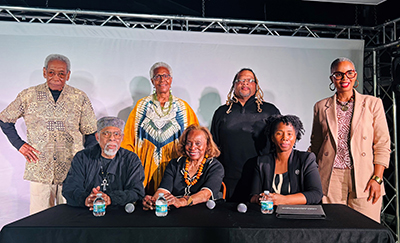
On Thursday, February 26, the South Florida Branch of the Association for the Study of African American Life and History (ASALH) co-sponsored a powerful forum at The Circuit on Sistrunk Boulevard in partnership with South Florida Community Partners, Inc. (SFCP), an environmental justice organization serving the region since 1996.
The evening began with a solemn libation ceremony led by Gene Tinnie, setting a reverent tone by honoring ancestors whose sacrifices paved the way for present-day struggles for justice. Serving as Mistress of Ceremony, Sheryl Dickey guided the program with poise and purpose, ensuring that the evening flowed seamlessly from reflection to critical discussion.
The forum’s theme, “Mis-Education as Environmental Injustice,” challenged attendees to examine the intersection between educational inequity and environmental disparities in historically Black communities.
The discussion drew a thoughtful audience familiar with the groundbreaking work of Carter G. Woodson, whose seminal 1933 book, The Mis-Education of the Negro, remains a cornerstone text in Black intellectual history. Dr. Woodson, widely recognized as the Father of Black History, founded Black History Week in 1926 — a movement that later evolved into Black History Month.
Speakers underscored how systemic miseducation contributes to environmental injustice — from zoning decisions and toxic exposure in marginalized neighborhoods to limited access to science, policy literacy, and environmental advocacy tools. The conversation highlighted the reality that knowledge gaps are not accidental but are often structured in ways that disempower communities most affected by environmental harm.
Although the audience did not fill every seat, the depth of information shared by dedicated and knowledgeable panelists resonated strongly with those present. Participants described the evening as intellectually stimulating and strategically important for coalition-building across advocacy sectors.
Organizers announced that the budding coalition intends to host a larger Town Hall-style gathering, expanding participation to additional community groups and stakeholders. While a specific date has not yet been determined, momentum appears to be building for broader engagement.
As Black History Month concluded, the message was clear: education — when rooted in truth — remains one of the most powerful tools for environmental justice and community liberation.