
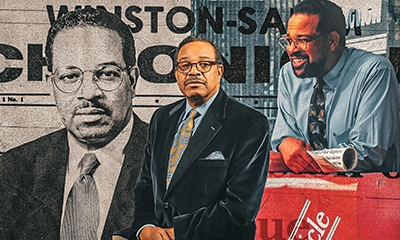
By Wali Pitt
(Source: HBCU GAMEDAY)
My father built a newspaper that made room for our stories. It took me years—and a journey through filmmaking—to understand how I would carry that work forward.
For the last 10 years, introducing myself at an HBCU football game or the CIAA Tournament has sometimes come with a second introduction.
I’ll tell someone my name. We’ll talk about HBCU Gameday, what we’re covering, or where I’m headed next. Somewhere in the conversation, the connection gets made.
I’m Ernie Pitt’s son.
Then come the stories.
They worked for him. They knew him through The Chronicle. He covered their team, supported their event, or gave them an opportunity. A sideline conversation becomes a trip back to Winston-Salem, back to my childhood, back to a world where being Ernie Pitt’s son was the introduction I was proudest to give.
My father, Ernest Harold “Ernie” Pitt, passed away October 23 at 80 years old.
He was a pioneering publisher, a Vietnam veteran, a community leader, and a member of the North Carolina Media & Journalism Hall of Fame. For 43 years, he led The Winston-Salem Chronicle, the Black newspaper he co-founded in 1974.
To me, he was Dad.
Before I understood the scope of what he had built, his newspaper was where I grew up.
Growing up at 617 North Liberty Street
The Chronicle was our family business in the fullest sense.
Both of my parents worked there full time. My mother, Elaine Lynch Pitt, worked behind the scenes throughout my father’s career, helping build and sustain the newspaper. Their work shaped our family’s rhythms.
I spent my childhood in and around the conference room at 617 North Liberty Street in Winston-Salem. Downstairs, a dark, dungeon-like basement housed an industrial printing press.
That was part of my childhood playground.
I grew up around the machinery that turned the work happening upstairs into something people could hold. I read newspapers with the ink still wet. Long before I understood publishing as a profession, I knew what a newspaper looked like before it reached somebody’s doorstep.
Eventually, I helped get it there.
I was one of the early kids in The Chronicle’s youth hawker program, selling newspapers and earning a percentage of the day’s sales. We were learning how to approach people, handle money, and take responsibility for what we earned.
At the time, I understood it as a way to make some money.
Looking back, I can see my father giving us an early education in ownership. He built a business around serving his community, and he made room for young people to learn from it.
HBCU sports were woven through that world, too.
My first courtside assignment did not go well
Growing up in Winston-Salem in the 1990s, the CIAA Tournament felt like an entire season of its own.
There was the basketball, of course. But there were also the vendors, the step shows, and the feeling that everybody had somewhere to be and somebody to see.
One year, when I was about 10 or 11, I got to be a ball boy.
For a kid who loved basketball, getting stationed under the basket at the CIAA Tournament was about as good as it could get. My assignment was simple: When a player fell, wipe the sweat off the floor.
Unfortunately, I was much better at watching basketball than at doing my job.
I cheered the three-pointers. Jumped at the dunks. I got so caught up in the game that I forgot I had a job until somebody yelled, “PITT!”
I ran onto the court, wiped the wettest-looking spot I could find, and hurried back, hoping nobody had noticed that I had no idea where the player had fallen.
The referee noticed.
He took my towel and cleaned the correct spot himself. The kid beside me got promoted to sweat duty.
My ball-boy career was over.
In 2016, I wrote about returning to the tournament with a camera, getting another chance to work courtside.
This time, the assignment was to pay close attention to the basketball.