
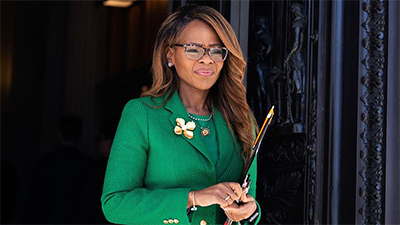
Sheila Cherfilus-McCormick
By Bobby R. Henry, Sr.
In a moment that is now drawing national attention and intensifying political pressure, Congresswoman Sheila Cherfilus-McCormick stands at the intersection of law, politics, and public perception.
A bipartisan panel of the House Ethics Committee has now concluded after a rare public hearing that she committed 25 of 27 alleged ethics violations, citing “clear and convincing evidence” tied to campaign finance and the handling of approximately $5 million in federal relief funds.
The findings elevate the stakes dramatically, opening the door to possible sanctions that could include censure or even expulsion from Congress once the full committee reconvenes.
Due Process in the Eye of the Storm
Yet even in the face of these findings, the Congresswoman’s position remains anchored in one principle: due process.
Responding to critics calling for her resignation, she argues that her constitutional rights are being compromised particularly citing limited time to prepare for the ethics hearing. Her framing is not just legal, but moral:
“Every American has constitutional rights… and mine are being trampled on.”
She further contextualizes the pressure as part of a broader political climate, especially in an election year—where optics can sometimes overshadow fairness.
But perhaps her most powerful assertion speaks beyond her individual case:
“Right now, it’s Black women. We need to protect America’s Black women.”
The Weight of 25 Violations—and the Fight to Respond
The Ethics Committee findings are significant. Investigators allege that millions in federal disaster relief funds were routed through a network of businesses and ultimately used to support her 2022 congressional campaign.
The panel rejected only two of the 27 allegations, reinforcing the seriousness of the case and intensifying calls from some lawmakers for her resignation.
However, Cherfilus-McCormick maintains her innocence and has pleaded not guilty to related federal charges brought by the U.S. Department of Justice.
When pressed for a detailed explanation, she has declined citing active legal proceedings but made a clear promise: She will “set the record straight” when legally permitted and her constituents will hear it first.
Public Trust vs. Political Narrative
While some in Washington question the impact of these findings on public trust, the Congresswoman redirects the conversation to her district.
She points to measurable outcomes:
- Over $583 million secured for community investment
- More than 2,000 constituent cases resolved
- Six bills passed into law
Her message is consistent: trust is earned in the community not just debated in the Capitol.
“Nothing will stop me from fighting for you.”
“Only the People Can Fire Me”
Even as pressure builds within her own party, her stance on resignation remains firm:
“My constituents hired me only they can fire me.”
This reflects a broader democratic argument placing ultimate authority not in political institutions, but in the voters themselves.
A Defining Moment for Accountability—and Equity
The case now moves into a critical next phase. The Ethics Committee is expected to recommend disciplinary action in the coming weeks, and any move toward expulsion would require a two-thirds vote in the full House.
At the same time, this moment raises deeper questions:
- How should ethics enforcement balance accountability and fairness?
- Are processes applied equally across all members?
- And how do race, power, and politics shape the outcomes?
More Than One Story—A Broader Message
This is not just the story of one Congresswoman. It is a reflection of a larger reality faced by many Black women in leadership:
- Elevated scrutiny
- High expectations
- And often, limited margin for error
Yet history shows that Black women have never stepped back from difficult moments they have stepped through them.
A Word to Black Women Leaders
To every Black woman leading, whether in public office, business, education, or community:
Stand firm in your purpose.
Let your work speak louder than the noise.
Trust that truth, when given its full day, will stand on its own.
Because in moments like this, the question is not just about survival, it is about legacy.
And legacy is not written by accusation alone.
It is written by endurance, by impact, and by truth revealed in time.
Sources: AP News, The Washington Post and Los Angeles Times