
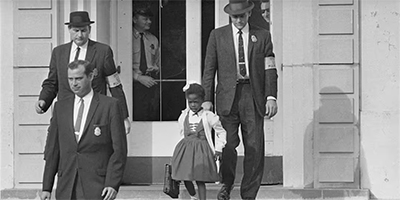
As a first-grader, her image became an emotional symbol for civil rights and educational equality.
By HISTORY.com Editors
At 6 years old, Ruby Bridges became the center of a landmark event in the civil rights movement as one of the first Black children to integrate an all-white public school in the American South. The image of Bridges—a first grader—escorted by federal marshals on her way to school among hostile protesters, became emblematic of racial tensions throughout the country.
Racial segregation was once legal in the United States, upheld by the doctrine of “separate but equal” established through Plessy v. Ferguson in 1896. As a result, Black children often attended segregated schools with fewer resources and opportunities. However, the landscape of American education began to shift in 1954 when racial segregation in public schools was declared unconstitutional through Brown v. Board of Education.
Many states were slow to comply, and it wasn’t until 1960 that Bridges and three other students would integrate the New Orleans school system. But while the other three students were enrolled together, Bridges enrolled alone.
Amid intense opposition at William Frantz Elementary on November 14, 1960, Bridges’ first day of school became an emotionally charged moment that endures as a symbol of the struggle for civil rights and educational equality.
How did the image of Ruby Bridges become so famous?
The image of the young schoolgirl was further immortalized by Norman Rockwell in his painting The Problem We All Live With. The work was featured as a centerfold in the January 14, 1964, issue of LOOK magazine—and remains one of Rockwell’s most iconic and provocative works.
Who was Ruby Bridges’ teacher?
Some parents chose to withdraw their children from William Frantz, and several teachers declined Bridges as a student. Educator Barbara Henry stepped forward and conducted lessons for an entire year, where Bridges was her sole student. “Even though there were mobs outside that school every day for a whole year, the person that greeted me every morning was [my teacher], a white woman, who actually risked her life as well,” said Bridges. The two were later reunited in 1996 on an episode of The Oprah Winfrey Show.
What happened to Ruby Bridges?
Bridges continues to work as an advocate for tolerance and racial equality. In 2001, she was awarded the Presidential Citizens Medal by President Bill Clinton.