
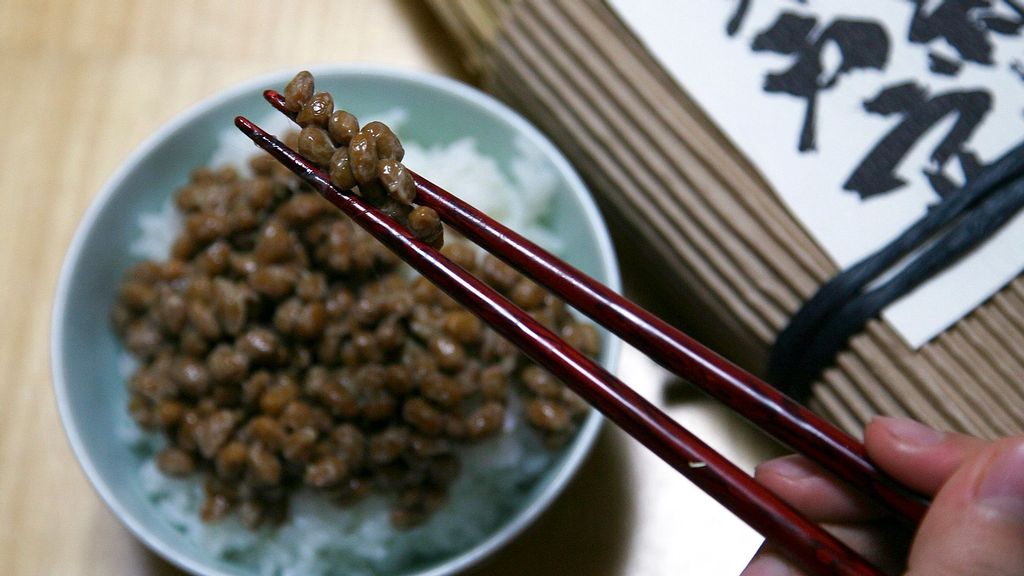
TOKYO — Japanese to the rescue! A new study reveals that a fermented soybean dish often served for breakfast in Japan may hold an answer to a modern problem: Covid-19.
The findings of the study were published in the journal ‘Biochemical and Biophysical Research Communications‘.
Natto, a breakfast dish in Japan, is made by fermenting soybeans with Bacillus subtilis, bacteria found in plants and in soil.
Long thought to contribute to longer, healthier lives across Japan — the country with the longest life expectancy on Earth and home to more than a quarter of the world’s population aged 65 years or older — natto was previously found to be a diet staple in those who were least likely to die from stroke or cardiac disease.
Now, researchers have found that extract made from the sticky, strong-smelling natto may inhibit the ability of the virus that causes Covid-19 to infect cells.
“Traditionally, Japanese people have assumed that natto is beneficial for their health,” said paper author Tetsuya Mizutani, director of the Center for Infectious Disease Epidemiology and Prevention Research at the Tokyo University of Agriculture and Technology (CEPiR-TUAT).
“In recent years, research studies have revealed scientific evidence for this belief. In this study, we investigated natto’s antiviral effects on SARS-CoV-2, the virus that causes Covid-19, and bovine herpesvirus 1 (BHV-1), which causes respiratory disease in cattle,” said Mizutani.
The researchers prepared two natto extracts from the food, one with heat and one without.
They applied the extracts to sets of lab-cultured cells from cattle and from humans. One set was infected with SARS-CoV-2, while the other set was infected with BHV-1.
When treated with the natto extract made without heat, both SARS-CoV-2 and BHV-1 lost the ability to infect cells. However, neither virus appeared to be affected by the heat-treated natto extract.
“We found what appears to be a protease or proteases — proteins that metabolize other proteins — in the natto extract directly digests the receptor-binding domain on the spike protein in SARS-CoV-2,” Mizutani said, noting that the protease appears to break down in the heat, losing the ability to digest proteins and letting the virus remain infectious.
The spike protein sits on the virus’s surface and binds to a receptor on host cells. With an inactive spike protein, SARS-CoV-2 cannot infect healthy cells. The researchers found a similar effect on BHV-1.
“We also confirmed that the natto extract has the same digestive effects on the receptor-binding domain proteins of the SARS-CoV-2 mutated strains, such as the Alpha variant,” Mizutani said.
While the results are promising, Mizutani said, he also cautioned that further studies are needed to identify the exact molecular mechanisms at work.
He also pointed out that the research does not provide any evidence of reduced viral infection simply by eating natto. Once the components are identified and their functions verified, the researchers plan to advance their work to clinical studies in animal models.
“Although there are vaccines for Covid-19, we do not know how effective they may be against every variant,” Mizutani said.
“It will also take time to vaccinate everyone, and there are still reports of breakthrough cases, so we need to make treatments for those who develop Covid-19.”
“This work may offer a big hint for such pharmaceutical design,” Mizutani said.
(With inputs from ANI)
(Edited by Amrita Das and Pallavi Mehra)
The post Covid: Has A Cure Bean Found In Japanese Food? appeared first on Zenger News.
