
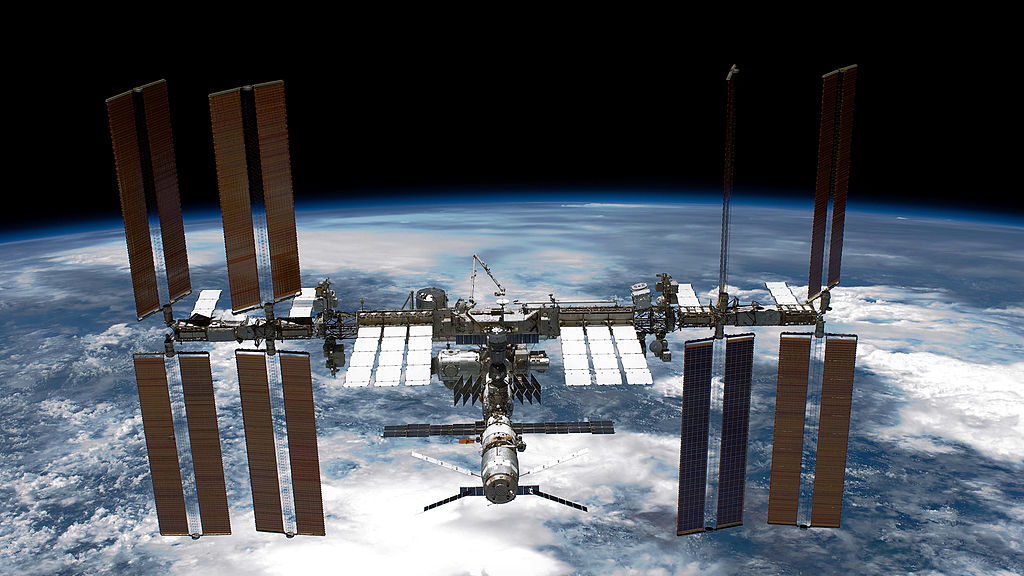
Forty-four experiments conceived by Israeli scientists, entrepreneurs and students will be conducted in outer space by Eytan Stibbe, who is set to become the second Israeli to leave Earth’s orbit.
A former Israeli Air Force fighter pilot, Stibbe is scheduled to travel to the International Space Station as part of Axiom Space’s AX1 mission in 2022. It will be the first space mission to the space station that will be manned entirely by private astronauts, and Stibbe is donating the $50 million cost of his trip and of the experiments that will be conducted.
Many of the experiments will not be space related, but rather will use the unique conditions found in space to test ideas and technologies from a variety of fields, such as optics, agriculture and neurology.
They were announced on May 5 at a conference held by the Israel Space Agency and the Ramon Foundation, which is named after Israel’s first astronaut, Ilan Ramon, and his family.
“Research in space is meant to break the boundaries of human knowledge, the attempts to resolve the unsolvable and decipher the unknown,” Stibbe said at the conference.
“What started out as a dream is taking shape before our eyes. The depths of a whole and fascinating world opened up before me, and every day I’m learning something new — thanks to you,” he told the crowd, which was made up of the entrepreneurs whose experiments he will be conducting.
View this post on Instagram
From optics to hummus
The Ramon Foundation said the selected experiments will come from the fields of optics (1), engineering (1), energy (3), agriculture (3), medicine-neurology (3), communications (3), astrophysics (5), medicine-ophthalmology (7), medicine-medical devices (7) and medicine-biology (11). They come from a variety of sources, such as universities, startups, hospitals and schoolchildren.
The Sheba Medical Center, for example, will be sending multiple experiments. One of them will examine the effects of space conditions on the virulence of Salmonella enterica bacteria that causes food-borne disease, and specifically the impact of microgravity conditions on their growth.
Another is set to investigate anti-viral T cell activation and the production of a T-cell bio-bank for astronauts traveling to space. A third will study the effects of microgravity on Alzheimer’s disease.
In the field of energy, Israeli company StoreDot partnered with the Israel Electric Corp. to test fast-charging technology for advanced ion-lithium batteries that could be used in electric vehicles. The zero-gravity conditions in space will enable it to identify irregularities in the surface of the batteries’ anodes, the company says.
Hummus is also going to be represented in the mission, with SpaceIL co-founder and Stanford PhD candidate Yonatan Winetraub sending off an experiment called “space hummus.”
Winetraub is collaborating with other scientists and teen students from southern Israel to grow chickpeas at the ISS using optogenetics, a genetic tool that controls plant growth. The point, they say, is that hummus is an easy-to-grow superfood, making it a strong candidate for outer-space agricultural efforts.
Other experiments include one from the Oncology Department and Schneider’s Children Medical Center. Researchers there want to examine the influence of sub-gravity on malignant cells with or without chemotherapy.
The study will analyze the changes in gene expression and in the proliferation of malignant cells in instances of T-ALL leukemia in sub-gravity conditions. It will explore innovative ways to treat the cancer, which is common in children, in a less toxic and more effective way.
Monitoring brain wellness
EEG-Sense aims to monitor Stibbe’s brain activity for 10 minutes twice a day, using a multi-sensor headset that incorporates artificial intelligence algorithms.
Data gathered from Stibbe could then be used to facilitate assessment of future astronauts’ cognitive wellness aboard their missions.
A joint Technion – Israel Institute of Technology and NASA experiment based on the physics of fluids under microgravity is going to try show that liquids in space can successfully be shaped into optical elements of high quality.
If this works, it could enable the in-space manufacturing of optical elements such as space telescopes that will be able to capture direct imaging of extrasolar planets.
The experiments will take off with Stibbe to the space station subject to approval by U.S. space agency NASA and Axiom Space, the Israel Space Agency noted.
These are the 44 selected experiments:
Agriculture
- The Promise of Fresh Duckweed, GreenOnyx, Dr. Dubi Shachal
- Space Hummus, Stanford University, Yonatan Winetraub
- Martian Agriculture Experiment (MARS), Brenner Regional High School (BRHS), Dr. Tal Feingersh
Astrophysics
- ILAN-ES, Interdisciplinary Center, Herzliya, Prof. Yoav Yair
- Gamma-ray burst Localizing Instrument (GALI), Technion – Israel Institute of Technology, Roy Rahin
- In orbit demonstration of the inline-screw-feeding vacuum-arc-thruster, Technion – Israel Institute of Technology, Space Plasmatics, Dr. Igal Kronhaus
- COTS-Capsule, Tel Aviv University, Yoav Simhony
- Astrorad Ergonomics Research, StemRad, Dr. Oren Milstein
Communication
- Space-to-Sea, University of Haifa, Dr. Roee Diamant
- Photonic Freespace – Qphoton Link, ELTA/QuantLR, Dr. Nissan Maskil
- NISSAN (Nano ISS Antenna Nisui), NSLComm, Daniel Rockberger
Energy
- Cosmo Cell Power System, Israel Electric Corporation – PV Nano Cell, Ira Perelshtein-Elbaz
- Flexible solar film for extra-terrestrial use to produce electricity, Solarapint (Apollo Power), Michal Dagan
- Silicon-dominant lithium-ion breakthrough experiment, Israel Electric Corporation – StoreDot, Gadi Gonen – Daniel Aronov
Engineering
Medicine-biology
- Anti-viral T cells, Sheba Medical Center, Tel Hashomer, Nira Varda-Bloom
- IAMI-RedC, RedC Biotech, Dr. Eran Schenker, Dr. Ari Gargir
- CRISPR-based genetic diagnostics in microgravity, Tel Aviv University, Dr. David Burstein
- Enhancing bone forming and muscle cells performances in microgravity conditions by amorphous calcium carbonate, Amorphical, Moti Tikotinski
- Space travel induced immune dysfunction, Sheba Medical Center, Dr. Yaacov Richard Lawrence
- Impact of space environment on human urinary microbiome, Thomas Jefferson University – Sheba Medical Center collaboration, Dr. Ben Boursi
- The effect of space conditions on the virulence of bacterial pathogens, Sheba Medical Center, Tel Hashomer, Prof. Ohad Gal-Mor
- The influence of sub-gravity on malignant cells with or without chemotherapy, Schneider Children’s Medical Center, Shai Mantzur
- Aging in space: the final frontier of brain star shaped cells, Tel Aviv University, Dr. Dan Frenkel
- Zeprion – Creutzfeldt Jakob Disease, Israel Creutzfeldt Jakob Foundation, Alice Anane
- In-situ cultivated meat production for space exploration, Aleph Farms, Pascal Rosenfeld
Medicine-medical devices
- Wristwatch monitor for heart conditions and vital signs in space missions, Israel Aerospace Medicine Institute (IAMI), CardiacSense, Dr. Eran Schenker, Eldad Shemesh, Meni Itzhak
- Inclusive neurological tests for space missions, IAMI-Encephalog, Montfort Brain Monitor, Israel Aerospace Medicine Institute (IAMI), Dr. Ziv Yekutieli, Dr. Eran Schenker
- IvyLife medical intravenous transfusion pump for space missions, IAMI-Medinfuze, Dr. Ami Glicksman, Dr. Eran Schenker
- Cardiac point of care ultrasound for space missions, Ultrasight, Israel Aerospace Medicine Institute (IAMI), Davidi Vortman
- SpacePharma Advanced (SPAD) Lab, SpacePharma R&D Israel, Dr. Lihi Efremushkin
- Urinalysis in space, Healthy.io, Yonatan Adiri, Ron Zohar
- Monitoring stress, ARC Innovation Center, Sheba MC, Thomas Jefferson University, Tunefork, Dr. Asaf Caspi
Medicine-neurology
- EEG Sense: Neuro-wellness study in micro gravity environment, EEG-Sense, Israel Deutsch
- BBB in space, Sheba Medical Center, Dr. Itzik Cooper
- Optimizing brain function in space with remote EEG and neurofeedback, Myndlift, Dr. Glen Doniger
Medicine-ophthalmology
- Digital tablet eye test for space missions, Israel Aerospace Medicine Institute, Bar-Ilan University, Dr. Eran Schenker, Prof. Uri Polat, Prof. Yossi Mandel
- IAMI-SlitTrek, Sheba Medical Center, Tel Aviv University, Israel Aerospace Medicine Institute, Prof. Ygal Rotenstreich, Prof. Haim Suchowski, Dr. Eran Schenker
- The eye in orbit, Rabin Medical Center, Dr. Gal Antman, Dr. Itay Gabbay, Dr. Iftach Yassur, Dr. Orly Gal-Or, Prof. Irit Bahar
- Evaluation of visual function during space flight, Tel Aviv University, Prof. Arieh S. Solomon
- Eye-tracking space, Israel Aerospace Medicine Institute, Dr. Eran Schenker
- In-flight monitoring of space travelers’ retina using advanced imaging system, ARC Innovation Center, Sheba Medical Center, Prof. Ygal Rotenstreich
- Shamir overhead spectacles for astronauts, Shamir Optical Industries, Noam Baran
Optics
Israel to send 44 experiments into space on new mission appeared first on ISRAEL21c.
The post Israel To Send 44 Experiments Into Space On New Mission appeared first on Zenger News.
