MLKEDC community meeting on stadium tax referendum stirs contentious debate
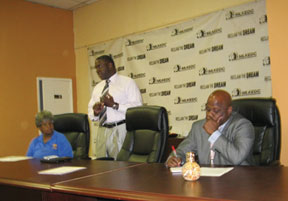
Sitting at left is Helen Stewart (MLKEDC Board of Directors Member); standing is Pastor Robert Jackson of St. Paul AME Church and the Rev. Willie Simms, associate pastor of Peaceful Zion M.B. Church.
By Derek Joy
The Martin Luther King, Jr., Economic Development Corporation held a community meeting on the hotel bed tax referendum in support of public subsidy for the renovation of Sun Life Stadium.
An overflow crowd packed the offices of the MLK Business Center last week.
“We’re here to discuss the lack of the benefits in the $389-million grant for Sun Life Stadium,” said Attorney Christine King,” president and CEO of the MLKEDC. “I believe this Agreement needs improvement. It needs tangible benefits for our community as a whole.”
“We’re here to foster dialogue on this issue,” King added, pointing to the Agreement crafted by the Miami Dolphins to show goals and commitment of its organization to the community. It will be a moot point if the State Legislature doesn’t approve the increase in taxes.”
Entering the last five days of the Legislation Session, the Florida State Legislature had yet to approve the legislation granting tax rebates to sports franchises and sports venues. The tax rebate would amount to some $3-million a year for 30-years.
When asked whether or not he had been contracted to do any of the renovation on Sun Life Stadium, Neal Hall, an architect and member of the MLKEDC Board of Directors said: “No. That isn’t the issue. We have Black professionals – engineers, architects and the like – here.”
Considering one anonymous person attending the meeting claimed billionaire Dolphins Stephen Ross is only putting up $33-million of the needed $389-million while the NFL is chipping in $158-million and some $200-million coming from public tax monies.
If that is true, tax rebates would allow Ross to recoup nearly triples his $33-million investment.
“We’re here together on the same side,” said Anthony Robinson of Miami First Initiative Team, who touted the contributions the Miami Dolphins have made to the community beyond sports and athletes.
“We want jobs for, both short term and long term. We want to assure you that there are opportunities for us to succeed. We’re making sure our community benefits as a whole.”
That assertion was called into question by more than one speaker.
Assessing the Agreement, Miami Dade Assistant State Attorney Keon Hardemon considered the designation of ’Paramount public purpose’ in the Agreement.
Said Hardemon: “When you read this Agreement, and I have, you’ll see in there ’Paramount public purpose. There is nothing paramount about renovating a privately owned football stadium with public money.”
“With or without public money the stadium will be renovated. Make them give us something paramount. Don’t just give them your vote because they gave you the Dolphins.”
Haredemon’s uncle, Billie Hardemon, a community activist and chairman of the MLKEDC Board of Directors, took a different tact.
“When they told me about this meeting I was hoping there would be whites here so I could give ‘em hell,” Billie Hardemon said. “You know how politicians are. They will promise you the world and once they get elected we all know what happens.”
“When it comes to this Agreement there is absolutely nothing in it for the Black community. And I say this after reading it. I know the Commissioners who voted for the referendum didn’t read it because the Dolphins didn’t give it to them until mid-night the day before they voted.
“The $289-million is not chump change. I have a fundamental problem with taxpayers’ money being given to a multi-billionaire to improve his personal property.”
The financial fiasco surrounding financing the Marlins Stadium has caused widespread public backlash.
Granted. Dolphins’ supporters can say this is different, even say they’re contributing far more to the cost of renovations than the Marlins paid to build their stadium.
And yes. The Dolphins are dealing a bit more above board and greater benefit to the over-all community than the Marlins did.
“What they’ll do is say we’re creating jobs for minorities. Where are we?”, asked Rev. Robert Jackson, pastor of St. Paul AME Church, who served on the Orange County Community Advisory Board when the Orlando Magic was seeking public subsidy to finance their arena.
“We’re in Miami. Hispanics are considered minorities here; even they are the majority. So you have to make sure there are front end and back end opportunities for jobs for the Black community. You have to tell them you want a percentage of the jobs.”
“They want to say we’re not paying the hotel tax,” Jackson added. “I bring people here all the time and put them up in those hotels. Where do I benefit?”
Added Rev. Willie Simms, associate pastor of Peaceful Zion M.B. Church: “As an African American in this community we’ve been left out of every major project here.”
“We voted for the Metrorail and they took it to Hialeah. We voted on the Port Tunnel, too. I see none of us involved at a major level.”
The community meeting prompted this comment from Dr. Robert Malone, an educational consultant and community activist: “I wish to God kind of accountability was in place when the Marlins Stadium issue came up. It’s mind boggling.”