By Dr. Mark H. James
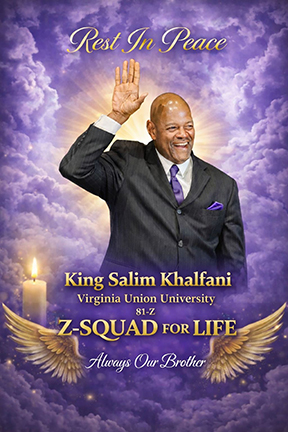
They don’t make them like King Salim Khalfani anymore.
On Monday, February 9, we lost more than a leader; we lost a compass, a conscience, and a flame that refused to be extinguished. When I received the news that my friend, my teacher, my mentor, and my brother had transitioned at age 66, the silence that followed was deafening. For more than three decades, Salim walked through the halls of Virginia power not with a welcome mat, but with a blowtorch; illuminating uncomfortable truths that others preferred left in shadow. Now we must learn to navigate those halls with only the memory of his light to guide us.
Born Edward Duane Hudson on April 24, 1959, in Cleveland, Ohio, to Edward and Marva B. Hudson, Salim was destined to become what Richmond so desperately needed but didn’t always deserve, a warrior unafraid to hold feet to the fire. A graduate of John F. Kennedy High School and Virginia Union University, he didn’t just study history; he was determined to make it. His activism began with the Richmond Peace Education Center and Virginians for Alternatives to the Death Penalty, early indications that his life would be spent protecting the vulnerable and challenging the powerful.
When Salim joined the Virginia State Conference of the NAACP in 1990 as Director of Branch and Field Activities and later served as Executive Director from 1998 to 2014, he didn’t seek approval from governors or glad-hand with the establishment. He sought justice. And he didn’t care whose feelings got bruised along the way. He built a reputation for confronting society’s ills with a singular focus that was at once intimidating and necessary. As Sa’ad El-Amin, former Richmond City Council member and fellow warrior, so aptly observed: “He was an advocate for all of the fundamental things that people of African descent needed.”
Beneath that confrontational armor was a teacher. To those fortunate enough to sit at his feet, me included, he offered a masterclass in Pan-Africanism, not as theory, but as practice. He taught that our struggles are interconnected, that the fight in Richmond echoes that in Johannesburg, and that liberation has no borders. He showed us that activism is not a performance or a pathway to personal glory. It is a responsibility. A debt owed to those who came before in chains, and those who will come after us.
“We haven’t had full employment since we were slaves.”
He dropped truths like that casually because, for him, history wasn’t past; it was a present obligation. He knew that employment was the real issue when others wanted to fight over murals. He knew that closing the mismanaged Richmond Juvenile Detention Center in 2012 mattered more than press releases, a victory he secured after railing against the center’s inhumane conditions for years. He knew that his fire made space for others to walk through doors he had to kick down.
His approach secured victories that extended far beyond any single issue. Whether lobbying at the General Assembly, hosting “African Perspective” on public access television for 7 years or serving as director of the Virginia Education Association’s UniServ program in Portsmouth and Hampton Roads, Salim remained committed to grassroots work. As criminal justice leader for the Virginia Interfaith Center for Public Policy and founder of Americans Resisting Minority and Ethnic Discrimination, he continued his work long after leaving the NAACP presidency in 2014.
But what made Salim extraordinary wasn’t just his public battles; it was his private generosity. Chelsea Higgs Wise, co-founder of Marijuana Justice for Virginia, first met him while she was still in high school. Like so many young activists, she found in him not a gatekeeper, but a guide. Whether explaining the NAACP’s work or joining Richmond youth during the 2020 Black Lives Matter protests, he made the next generation feel proud of their contributions. He gave us permission to be difficult. Permission to demand what you’re owed. Permission to stop asking nicely for a seat at a table that was never built for us and instead flip the damn table over.
Bernice Travers of Living the Dream Inc. remembers when they helped build a coalition of Black Virginia leaders in the 1990s to address key community issues with Gov. George Allen. “He felt that if we didn’t stand up, fight, and join the struggle, nothing would change, and he was that change agent,” Travers recalled. That commitment never wavered.
He is survived by his father, Edward; his beloved sister, Kristen; his children, Queen Nzinga Khalfani and Suten Ramessu Khalfani; his niece, Zoe Asanti Griffin; his nephew, William Burks Hudson; and a host of friends who were family by choice.
He worried about the void he would leave. About whom would come after the generation of warriors: Ray Boone, Jack Green, Sa’ad El-Amin, Marty Jewell, and himself, who practiced a fading brand of activism born from the civil rights movement’s crucible.
“Somebody will step up,” he once told me during one of our Red Lobster “all you can eat shrimp” days, if you know, you know.
Perhaps that was his final gift: the belief that once you’ve shown people what a warrior looks like, once you’ve taught them the weight of their responsibility to their people, you never truly leave them. The fire he carried, the lessons he imparted, now belong to those of us who learned at his feet.
Rest in power, my teacher. My mentor. My friend. The feet are still warm. And your students are still watching.
ASE.