 Entire female reproductive tract susceptible to HIV infection in macaque model
Photo Credit By Thomas J. Hope et al., CC BY 2.0
Most women are infected with HIV through vaginal intercourse, and without effective vaccines or microbicides, women who cannot negotiate condom use by their partners remain vulnerable. How exactly the virus establishes infection in the female re-productive tract remains poorly understood.
A new study reports surprising results from a study of HIV transmission in the FRT of rhesus macaques.
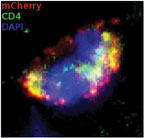
This is an infected ovarian cell staining positive for mCherry (red) and the HIV-1 receptor CD4 (green).
This is an infected ovarian cell staining positive for mCherry (red) and the HIV-1 receptor CD4 (green).Most women are infected with HIV through vaginal intercourse, and without effective vaccines or microbicides, women who cannot negotiate condom use by their partners remain vulnerable. How exactly the virus establishes infection in the female reproductive tract (FRT) remains poorly understood. A study published on October 9th in PLOS Pathogens reports surprising results from a study of HIV transmission in the FRT of rhesus macaques.
Most studies of HIV trans-mission after vaginal exposure to date have been done in rhesus macaques and focused on the cervix, the lower part of the uterus that meets the vagina. Thomas Hope, Daniel Stieh, both from Northwestern University, Chicago, USA, and colleagues went beyond what they call “cervix-centric studies” to take a fresh look at the initial events taking place throughout the FRT that lead to HIV infection.
To do this, they constructed an artificial virus (or vector) that can enter host cells and deliver so-called reporter genes that can label infected cells in the macaque FRT. The vector used the same mechanism of initiating infection in host cells as Simian Immunodeficiency Virus (or SIV, the macaque counterpart of HIV), but it was unable to multiply and spread. It was therefore present only in cells that were directly infected (or “transduced”) after introduction of the vector into the vagina.
Instead of generating new virus, the vector expresses two reporter genes, one coding for luciferase (a firefly enzyme that creates the glow of luciferin) and the other for a red fluorescent protein called mCherry. Having two different reporter proteins in infected cells makes it possible to first do a low-resolution scan of the tissue to hone in on areas with infected cells containing luciferase, and then use high-resolution microscopy to visualize the individual infected cells high-lighted by mCherry.
Within 48 hours after vaginal introduction of the vector into 8 macaques, the researchers detected infected cells — mostly T cells — throughout the entire FRT, including the vagina, cervix, ovaries, and local lymph nodes. Most animals had more than one site of infection. The most common sites were the vagina and outer cervix, followed by the ovary. Infection in the inner cervix and lymph nodes were each seen in one animal.
Given the limited number of animals and varying stages of the menstrual cycle, the study can’t quantify the risk of infection per specific location. However, it indicates that virus can travel throughout the reproductive tract and that sites of initial infection are not restricted to specific domains within the FRT. Based on their findings, the researchers conclude that “the entire FRT should be considered as potentially susceptible to HIV infection, and mechanisms for prevention of HIV acquisition must be present at protective levels throughout the entire FRT to convey protection.”
The presence of retroviral infection in the ovary also offers a possible solution to a longstanding mystery, namely how retroviruses can enter the human genome. The decoding of the genome revealed that retroviruses have infected our ancestors repeatedly over evolutionary time, including as recently as 100,000 years ago. Retroviruses are also present in the genomes of all other animal species. To be passed on to the next generation, the retroviruses have to infect germ cells (egg, sperm, or their cellular precursors).
Michael Emerman, from the Fred Hutchinson Cancer Center, Seattle, USA, who studies the evolution of the human-retrovirus interaction, and was not involved in the study, commented, “The proof that retroviruses entered into the genome of humans repeatedly in the past is present in every cell in the body of every human.
The ability of virus introduced into the vaginal tract to infect cells in the ovary reveals one possible mechanism of how retroviruses could have entered the germ lines of human ancestors.”