 Don’t turn a blind eye to Diabetic eye disease
Set your sights on healthy vision
By Amber Evans
It may be hard to believe, but diabetes affects more than 29 million people in the United States. That is about one in 10 people! People with diabetes have a lot to consider when thinking about their health, but what might get lost in the shuffle is how diabetes may affect their eyesight. All people with diabetes, type 1 and type 2, are at risk for diabetic eye disease, a leading cause of vision loss and blindness.
Diabetic eye disease isn’t just one disease, but a group of eye problems that can affect people with diabetes. These include cataract, diabetic retinopathy, and glaucoma. Diabetic retinopathy is the most common diabetic eye disease and the leading cause of blindness in people 20–74 years of age.
An estimated 7.7 million people ages 40 and older have diabetic retinopathy and by 2030, that number is expected to increase to approximately 11 million people. Unfortunately, diabetic eye disease often has no early warning signs.
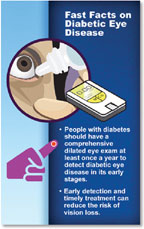
“The longer a person has diabetes, the greater is his or her risk of developing diabetic eye disease,” says Paul A. Sieving, M.D., Ph.D., director of the National Eye Institute (NEI). “If you have diabetes, be sure to have a comprehensive dilated eye exam at least once a year.
Diabetic eye disease often has no early warning signs, but can be detected early and treated before vision loss occurs. Don’t wait until you notice an eye problem to have a dilated eye exam, because vision that is lost often cannot be restored.”
Unlike a regular eye exam you get for new glasses or contact lenses, a comprehensive dilated eye exam allows your eye care professional to get a more in-depth look at the health of your eyes. He or she will put drops in your eyes to dilate, or widen the pupil and then examine your eyes to look for common vision problems and damage from eye diseases, many of which have no early warning signs.
People with diabetes can help slow the progression of diabetic eye disease by maintaining good control of their blood sugar, blood pressure, and cholesterol.
For more information on diabetic eye disease and tips on finding an eye care professional or financial assistance for eye care, visit http://www.nei.nih.gov/diabetes or call NEI at (301) 496-5248.