 Florida Senate approves making coding a foreign language
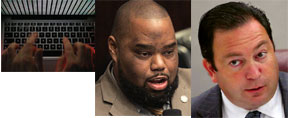
Sen. Bullard and Sen. Ring
By Madison Iszler, USA TODAY
Florida senators approved a bill allowing high school students to take computer coding classes in place of foreign language requirements.
The bill (SB 468), introduced by Sen. Jeremy Ring’s (D-Parkland), won by a 35-5 vote. It will take effect during the 2018-19 school year. Technological skills are a necessity “for every industry,” Ring told USA Today.
“It’s ahead of its time, but in reality, it’s in its time,” Ring said. “If you don’t have an understanding of technology, you will be left behind. It’s a basic skill, as much as reading and writing.”
Local groups are not pleased. The NAACP’s Florida Conference and Miami-Dade branch, the Florida chapter of the League of United Latin American Citizens (LULAC) and the Spanish American League Against Discrimination (SALAD) released a joint statement disputing the bill, reports The Tampa Bay Times.
“Our children need skills in both technology and in foreign languages to compete in today’s global economy,” the statement reads. “However, to define coding and computer science as a foreign language is a misleading and mischievous misnomer that deceives our students, jeopardizes their eligibility to ad-mission to universities, and will result in many losing out on the foreign language skills they desperately need even for entry-level jobs in South Florida.”
Under the bill, which has undergone several revisions, high schools may offer students the opportunity to take computer coding courses. Originally, the bill said that high schools “must” allow students to do so.
The measure requires Florida College System institutions and state universities to accept two coding credits in place of the current two-credit foreign language requirement, though Florida’s Bright Futures scholarship program is not mentioned. Parents and students must sign a statement indicating that the switch may not meet the requirements of certain colleges and universities, according to the bill.
For school districts without coding courses, students can take classes through Florida Virtual School, a state-funded online school.
In a statement, Ring cited the support of influential tech companies and educational institutions such as the Associated Industries of Florida, Motorola Solutions, the Florida Tech Council, TechNet, and the Florida Parent Teacher Association in creating the bill. Ring called learning to code “the great educational equalizer.” He believes Florida is leading what will soon become a national trend in education, calling the bill “innovative.”
But critics worry that the bill places a financial burden on public schools already lacking sufficient technological resources. The bill does not mention funding for courses or increasing students’ access to computers.
“What I’m fearful of is …certain students in certain zip codes may not have access to those kind of classes … how do you foresee this rolling out and being equitable?” said Sen. Dwight Bullard, as reported by The Orlando Sentinel.
Ring called complaints and concerns regarding funding “disingenuous,” citing Florida’s education budget and the option of using Florida Virtual School if schools do not have the resources. “If a school can’t afford instruments, should every school eliminate music classes?”