Preaching from the Pulpit: The history of Black churches in the struggle for freedom in America
By Staff Writer
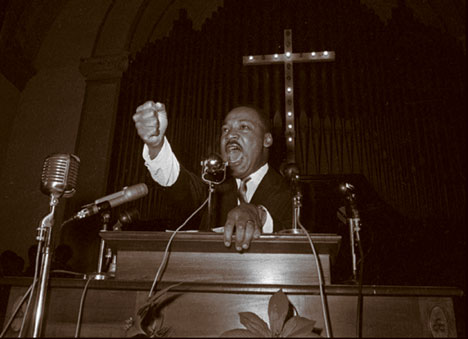
Ever since this country was founded, religion has played an integral role in shaping America’s moral or, some would contend, its immoral fabric. From the famous phrase, “In God we trust,” found in the United States Constitution as orchestrated by the so-called “Founding Fathers,” to those words so eloquently spoken by the late civil rights leader, Dr. Martin Luther King, Jr., who said, “Free at last, free at last, thank God Almighty, we’re free at last,” at the conclusion of his “I Have a Dream” speech, during the 1963 March on Washington D.C.
It is impossible to discuss the history of Black churches in America without putting it into the context of the struggle by Blacks for freedom and justice in this country.
Even though Blacks such as Frederick Douglass and Sojourner Truth are the most well known among those who played major roles in the Abolitionist Movement which occurred during the18th and 19th centuries here in the United States, from a religious standpoint, Reverend Richard Allen epitomizes those clergy members who fought to emancipate Black people through the establishment of their own churches, which were under their own authority and not subject to rule by the white church establishment.
The African Methodist Episcopal Church (AME) grew from the Free African Society (FAS) which Richard Allen, Absalom Jones, and others established in Philadelphia, Penn. in 1787. This came on the heels of an incident which happened at St. George’s Methodist Episcopal when Blacks were forcible stopped from praying on their knees in the church. Racial discrimination drove Blacks to seek their own formalized church, resulting in the establishment of Bethel AME in 1894 under the leadership of Allen. Initially, the AME church only existed in the Northeast section of the country in states such as Pennsylvania, New York, Massachusetts, spreading westward to Michigan, Ohio, and Illinois, and southward including; Washington, D.C., Maryland, South Carolina, Kentucky, and Louisiana.
The AME church underwent tremendous expansion during the Civil War and Reconstruction. AME clergy under the authority of the Union Army were able to move about in the South in the cradle of the Con-federacy to recruit newly freed slaves into the ranks among their congregations. “I Seek My Brethren,” became a rallying cry and popular theme in the sermons of Black preachers in need of church members who were in search of a new life not far removed from the shackles of slavery.
Another major church denomination arose in the late 19th century – The National Baptist Convention (NBC). On Saturday, Nov. 22, 1880, 151 people representing 11 states met in Montgomery, Ala. and established the Baptist Foreign Mission Convention of America (BFMCA). The Reverend W.H. McAlpine of Alabama was elected its first president. Fast forward six years later in 1886. Six hundred delegates from 17 states gathered at the First Baptist Church in St. Louis, Missouri and formed the National Baptist Convention of America (NBCA). Seven years later in 1893, the National Baptist Education Convention (NBEC) was formed.
In 1895 the three organizations merged during a meeting at the Friendship Baptist Church in Atlanta, Ga. The Reverend E.C. Morris became its first president to preside over what is now known as the NBC, USA, Inc. Prior to that time, nine men served as president of the Black Baptist organization and eight have served as president until this day.
Black liberation theology teaches that all men are created equal under God and teaches through biblical principle that African Americans have a God-given right to be empowered spiritually, socially, politically, and economically free from the subjugation of racial oppression.
The Reverend Dr. Mack King Carter is Pastor Emeritus of the New Mount Olive Baptist Church in Fort Lauderdale, Fla. He offered several observations regarding the role of the Black church during the Civil Rights Movement which began during the mid 1950’s.
“I think that was the church’s finest hour in so far as the progress of our people dealing with racism in this country,” said Dr. Carter.