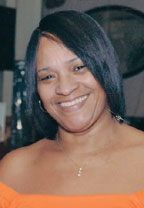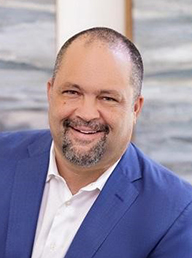
Next June marks 60 years since Loving v. Virginia. My parents did not wait for it.
By Ben Jealous
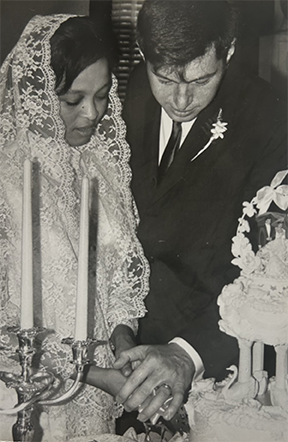
This month my parents are beginning their seventh decade of marriage despite a law that tried to stop them.
Sixty years ago they were married in a church in Washington, D.C. They had to leave Maryland to do it. My mother is Black. My father is White. In Maryland their marriage was a crime.
They met in West Baltimore. Her city. Two student teachers at Harlem Park Junior High, the same classroom, one semester after the other.
They wrote each other every week that spring. Their students. Life back on campus. What they believed. When my mother came home to Baltimore for the summer, they were both seeing other people. They went on a date anyway.
That date was at the recently desegregated movie theater. They slipped in like racial fugitives. They found two empty seats. He walked down one aisle. She walked down the other. They sat side by side but didn’t want their entrance or exit to cause a stir. They knew the looks wouldn’t all come from White people. It was the summer of Black Power, after all.
My father proposed three times in two weeks. She turned him down twice. She was not being coy. What he asked was against the law. The third time she said yes.
My father’s uncle told him he believed the love was real. Then he explained that if my father wanted to stay in the family, and in his grandfather’s will, he would need to fall in love with someone else instead. Others said, “Think about what it will be like for the children.”
They married two months later. They arrived at the church separately, the way a bride and groom do. This time it was tradition.
Afterward the caravan drove back to Baltimore with its headlights on. Cars on the highway pulled aside to let it pass. In the city people stopped walking to turn and stare and then pray for them. Men took off their hats. Everyone thought it was a funeral. The lights were only so nobody would get lost on the way to my grandparents’ house in West Baltimore, where the reception was.
At the reception my father danced with my mother. He is red-headed and freckled and looks as English and Irish as he is. One woman watching them decided the groom had to be Black. Apparently she could not imagine a White boy dancing like that. My father was delighted.
Somewhere in there my father made her an offer. Jealous is a strange name to carry. He told her he would take hers instead. He would become Fred Todd.
She said no. She took the name Jealous.
Telling that used to make me chuckle. Who turns down any name for such a notorious adjective? I hear it a little differently now.
His grandfather had already disowned him and cut him out of the will. His own father had died years earlier, of his third heart attack. My father was the eldest grandson of an industrialist. He had a great deal to lose and he lost all of it. His mother and his brothers stood by him. Much of the rest of the family did not. His name was the last thing that was his to give, and he offered to give that up too. She would not let him.
The following June the Supreme Court decided Loving v. Virginia. When my parents stood in that church, nobody knew it was coming. They married anyway.
They went west. With Loving grinding through the courts, they apparently decided the nation didn’t need Jealous v. Maryland too.
San Diego first, then the Monterey Peninsula. There my father taught soldiers home from Vietnam, many of whom could not read. Later he founded a community where men learn to listen to one another, and to be listened to, most of them for the first time. My mother spent her career as a therapist. They raised us in California, far from her mother and her church and her city.
Every summer they sent me back east. Baltimore for her people. Maine for his. The move had cut them off from all of it. They handed it to me.
A decade ago they returned to St. James Episcopal Church on Lafayette Square and renewed their vows for the 50th anniversary of Loving. My mother was baptized in that church. So was I. So was my son.
My mother wore the dress. Her grandmother sewed it for her in 1966, when my mother was 25. She sewed it for that church, where she worshipped. Then the law sent the wedding to Washington, and the dress never went down that aisle.
A half century later it did. My mother was crying. I told her to stop bragging. She looked at me, confused, tears still on her face. I told her she just wanted everybody to know it still fit.
Sixty years. My father is still the man who offered to give up his name. My mother is still the woman who would not let him.
They were never a test case. They were a marriage. They still are.
Happy anniversary, Mom and Dad. Thank you for being so courageous in love. My sister and I literally would never have existed but for it.
Ben Jealous is a professor of practice at the University of Pennsylvania and former president and CEO of the NAACP.