Nearly two centuries after the first Black woman preacher, more women are called to ministry — but tradition and bias still keep many from the pulpit.
By Rev. Dorothy S. Boulware
(Source: Word In Black)
Overview:
While there are some who preach, others who lead, and even an AME bishop, fewer than 1 in 10 Black church leadership positions are led by Black women. That’s despite the fact that 8 in 10 Black church congregants are Black women. Experts say progress has been slower and uneven than expected.
Born into a free Black family in the late 1700s, Jarena Lee was just 24 when she heard the call to ministry as a member of the newly-formed African Methodist Episcopal Church. Though founders banned women from the pulpit, Lee persisted: “If the man may preach, because the Savior died for him, why not the woman, seeing He died for her also?”
After seeing her captivate an audience with a sermon, church leaders eventually gave Lee permission to preach.
In the nearly two centuries since Lee’s historic accomplishment, Black women have made significant progress in ministry across historically Black denominations. That includes the elevation of Rev. Vashti Murphy McKenzie, the AME’s first female bishop.
Yet even as generations of Black women quietly became the spiritual backbone of Black denominations — organizing missionary societies, leading choirs, teaching Sunday school, even preaching — most pulpits and highest leadership offices in are still overwhelmingly reserved for men.
In the Pews, Not at the Pulpit
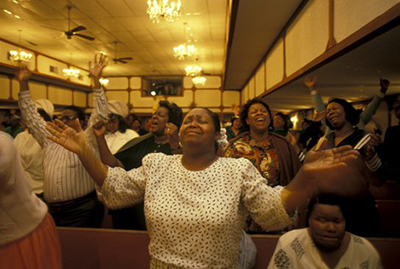
Researchers estimate that fewer than one in ten Black Protestant congregations is led by a woman, despite the increasing number of women entering ministry. Studies show most Black church congregations are overwhelmingly female.
Talk to Black clergywomen, however, and they say the challenge is not calling or preparation but acceptance.
“We are a culture that has historically put more value in the men’s voice,” said the Rev. Dr. Erika D. Crawford, a pastor in the African Methodist Episcopal Church and leader of its Commission on Women in Ministry.
Rev. Christine A. Smith, a theologian, author and senior pastor of Restoration Ministries of Greater Cleveland, Ohio, summarized the challenge: “We do have some very successful African American pastors. But those women are the exception, not the rule.”
We are a culture that has historically put more value in the man’s voice.
Rev. Dr. Erika D. Crawford, AME CHurch Commission on WOmen’s Minsitry
It is commonly known that the influence of women in the Black Church has long exceeded their official authority. Studies estimate that women comprise between 66% and 88% of the membership in many African American congregations, making them the majority presence in pews and volunteer ministries.
Yet leadership roles, particularly the senior pastorate, have lagged behind that demographic reality.
Overcoming Stigma
Dr. Nicole Davis, author of “Eve, Where Are You? Confronting Toxic Practices Against the Advancement of Women,” wrote in her book that women “are meant to lead and serve fully in ministry.” But she also believes that harmful or toxic practices among male leaders hold women back.
Davis hadn’t always felt this way. Her perspective changed after a confrontation with her son, who was appalled to discover the church their family attended didn’t believe in female pastors. While Davis knew it wasn’t right, she had accepted it until that conversation.
Confirmation from God, in the form of her graduate studies, followed.
“I pursued a doctorate in conflict analysis and resolution, and studied the impact of the patriarchal system on gender imbalance,” Davis wrote. The research clarified “how various female pastors overcame the stigma that I came to accept as facts of life.”
Not long afterward, ”I changed churches and was soon thereafter ordained to function as an associate pastor,” Davis wrote. By embracing her identities — specifically, her gender and faith — Davis wrote she “can now fully recognize my value and ministry opportunities in all these areas” and concentrate on what truly matters.
“It is God whom I desire to please, and I’ve learned that He needs the women He calls to show up and step into the light,” she wrote.”
The Stained-Glass Ceiling
Bishop Andrea Foster of Kingdom First Assembly Church in Rock Hill, South Carolina, acknowledges there are problems, but says there is clear evidence of progress, especially in the last 30 years: “I think you’re finding more women in top-tier leadership positions.”
In the Episcopal church “more women are breaking the glass ceiling,” Foster says.
Nevertheless, women are usually held to a higher standard than men, Foster says, as well as expected to suffer “the foolishness and abuse” of men in church leadership. But greater expectations, she says, can cut both ways.
“I think churches are open to the nurturing theological because if you’re a woman in ministry, for the most part, you can’t come raggedy,” she says. “You have to know your stuff. I don’t know too many women coming to pulpit ministry or other types of ministry with fluff.” While she loves “my brothers,” Foster says, the different expectations for women often cultivates “a fearlessness” at the pulpit that men sometimes lack.
Women “are coming with sound doctrine. They’re coming with sound teachings,” she says. “And I think it takes a boldness and a prophetic edge” to do so.
Recognition, Not Representation
Despite institutional barriers, attitudes among churchgoers appear to be shifting. A Pew Research Center survey found 86% of Black Americans believe women should be allowed to serve as senior religious leaders, including strong support from both men and women.
Historians note that while progress has been gradual, the trajectory is clear. The combination of theological education, congregational support, and persistent advocacy continues to open doors.
For many clergywomen, the goal is not simply representation but recognition of a calling that has always existed.
Yet even with public support, women often find themselves serving in smaller congregations or in associate roles rather than leading large churches. For many clergywomen, the goal is not simply representation but recognition of a calling that has always existed.
As scholars of African American church life often note, women have long been the spiritual lifeblood of the Black Church. The current generation is working to ensure that the authority of the pulpit reflects the faithfulness already present in the pews.