 Black women protest delay in confirming Loretta Lynch
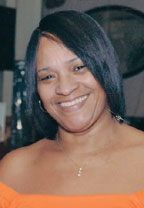
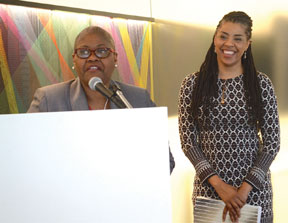
Melanie Campbell (l) and Avis Jones-DeWeever protest delay in confirming Loretta Lynch.
By Jazelle Hunt, NNPA Washington Correspondent
WASHINGTON, D.C. (NNPA) – Hundreds of Black women and girls representing the Black Women’s Roundtable descended on the nation’s capital last week to petition the Senate to confirm U.S. Attorney Loretta Lynch as the next attorney general.
“Loretta Lynch has been waiting over 140 days to get a vote on the floor. That’s never happened in the history of this country,” says Melanie Campbell, convener of the Roundtable, and president and CEO of the National Coalition on Black Civic Participation (NCBCP).
The Black Women Round-table is the intergenerational arm of the NCBCP.
“They’re holding her up because they’re having a partisan battle,” said Campbell. “…. Why is this happening to a Black woman? The American people believe in fair play. It’s not fair, and it’s not correct.”
Campbell was one of about two-dozen members of the Roundtable who visited Senate Majority Leader Mitch McConnell’s (R-Ky.) office on Thursday and attempted to meet with him on the matter. They were told he was busy and would not be able to meet with them, or greet them.
The women held a prayer vigil outside his office; security was called, but did not escort them out. They were able to meet with McConnell’s chief of staff; Campbell describes his response as “on-message stock answers.”
In addition to meeting with representatives, the Black Women Roundtable (BWR) released its 2015 Black Women in the United States report.
“This report is a little bit different than the last one in that it gives both the 50,000-foot view by providing data analysis across a variety of areas and indicators,” said the report’s editor, Avis Jones-DeWeever. “But in addition to that, it’s augmented by the stories from women…who are BWR members in states all across this country, whose voices are literally infused into this report. So you not only get the data, you also get the narratives behind the numbers.”
A similarity it shares with last year’s inaugural edition is the mix of celebration and concern.
And the concerns are many. First, every state with a large Black population, with the exception of Maryland and Delaware, plus Washington, D.C., is home to high numbers of uninsured Black women. All of the states in question have refused to expand Medicaid coverage under the Affordable Care Act. At the same time, reproductive services are disappearing in these states, resulting in a rising maternal mortality rate among Black women, from 30 to 42 deaths out of 100,000 live births (compared to 12 deaths for white women).
“Already as it stands, Black women have maternal mortality rates that are frankly unheard of anywhere else in the industrialized world,” Jones-DeWeever said at the report release event. “If you are a Black woman in America, you have a better chance of surviving childbirth if you gave birth in Libya than in the United States of America. Our women are dying because of lack of care, and there’s no excuse for that.”
Black women also experience violence at disproportionately high rates; they’re more than twice as likely as all women, and three times as likely as White women, to be murdered. More than half of Black women who knew their murderers were romantically involved with them.
Economic success is another uphill battle. Despite national gains, Black women’s unemployment has remained the highest among all women – 8.9 percent compared to the national rate of 5.5 percent. While that’s lower than last year, the rate has been on a slow rise, contrary to unemployment stats for other women.
In the report, wage disparities play out across income categories, and especially across education levels. For example, Black women with master’s degrees earn slightly less than Black men with bachelor’s, and white men, Asians, and Latinos with associates or post-secondary degrees.
The good news, though, is that Black women are seizing political power as never before.
This year, Alma Adams (D-N.C.) became the 100th Black woman elected to Congress. There are two new Black-woman mayors of major cities. Two new congressional representatives became the first Black congresswomen elected from their states (New Jersey and Utah), and Mia Love became the first Black woman ever elected to Congress as a Republican. There are two Black women running for Senate in 2016 – It’s been 17 years since a Black woman has occupied a Senate seat.
Three Black women representatives, Rep. Yvette Clarke (D-N.Y.), Rep. Eddie Bernice Johnson (D-Texas), and Rep. Stacey Plaskett (D-VI), were also present at the launch and spoke on the need to be involved in the reproductive, civil, and human rights, and other political conversations that impact Black women most.
The Black Women in the United States report is released each year as part of the BWR’s National Women of Power Summit, which brings girls and women from all over the nation to exercise their civil rights, develop solutions for sociopolitical problems, and honor Black women making strides in these areas.
“We try to bill the summit as an organizing summit…we’re going to take our key priority issues, delve deep, and then…get into smaller groups and talk strategy,” Campbell said. ““We’re not a research institute, but we know we have to have good data to be able to quantify what we’re doing [and] to understand what’s going on with us. We try making sure we tell the story about the challenges, but also what we’re doing well.”