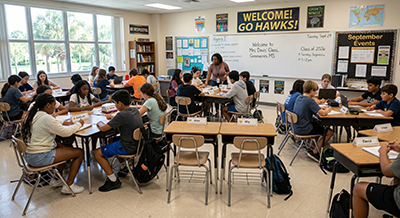
Districtwide enrollment is falling, but some classrooms are packed. A new review will determine whether schools are exceeding Florida’s class-size requirements and whether recent staffing cuts are contributing to the problem.
Broward County Public Schools is facing a question that may seem difficult to reconcile: How can a district with roughly 60,000 empty seats also have classrooms that parents say are overcrowded?
That is what the Broward County School Board is now trying to determine.
The board has directed Superintendent Howard Hepburn to conduct a districtwide review of class sizes and staffing. The review will identify classrooms and core-curriculum sections that exceed or are projected to exceed Florida’s class-size requirements, as well as schools and grade levels where student enrollment significantly exceeds district staffing guidelines.
The review follows complaints from parents who say some kindergarten and first-grade classrooms have had as many as 25 students since the beginning of the school year.
Florida law generally limits core classes to 18 students in prekindergarten through third grade, 22 in grades four through eight and 25 in grades nine through 12, although the way compliance is measured can vary by grade, school and other factors.
School Board member Adam Cervera, who represents District 6, requested the review after hearing complaints from parents.
“Parents in District 6 keep telling me the same thing: classrooms are too crowded for kids to learn and too crowded for teachers to teach,” Cervera RECENTLY said in a social media post.
Cervera said some kindergarten and first-grade classrooms have had 25 students since the start of the school year and argued that the district needs to bring those classrooms into compliance.
But the bigger issue is why overcrowding could be happening in some schools while Broward has so much unused capacity elsewhere.
Fewer students, but not necessarily fewer students everywhere.
BCPS began the 2026-27 school year with 11,358 fewer students than the previous year. The decline has left the district with an estimated 60,000 empty seats and contributed to an estimated $100 million reduction in funding.
That does not mean every school has fewer students.
Enrollment changes are uneven. Some schools have lost significant numbers of students, while other campuses have enrolled more students than district officials expected.
That creates a staffing problem: a district can have thousands of empty seats overall while individual classrooms are still short of teachers.
Teacher allocations are initially based on projected enrollment. Once the school year begins and actual enrollment becomes clearer, the district can move teachers from schools with fewer students than expected to schools where enrollment is higher.
The district can also hire additional teachers when necessary.
That process is now under scrutiny.
Did staffing cuts contribute?
Cervera has connected the classroom-size concerns to a restructuring plan approved by the School Board in May, when the district was looking for ways to reduce costs because of declining enrollment.
Cervera was one of two board members who voted against the plan. He said the restructuring eliminated too many student-facing positions while leaving too much bureaucracy in place.
He also said the district had lost “hundreds of certified teachers” and argued that the staffing reductions have contributed to larger classes.
Hepburn has disputed the idea that the cost-cutting plan was designed to reduce classroom teaching positions. District officials have said teacher allocations are tied to enrollment and can be adjusted as actual student counts become known.
That distinction is important.
The district has not yet established that the reported overcrowded classrooms were caused by the restructuring plan. The requested review is intended, in part, to determine where the staffing and enrollment problems actually exist.
What happens next?
The School Board is waiting for the superintendent’s report.
That report is expected to provide a clearer picture of which schools and classrooms are actually exceeding state requirements, which are approaching the limits, where staffing does not match enrollment, and whether additional teachers need to be moved or hired.
Until the report is released, it remains unclear how widespread the alleged violations are.
For parents, however, the issue goes beyond the numbers.
A district with declining enrollment should, in theory, have opportunities to reduce class sizes. But if students are concentrated unevenly across campuses, the district can still face overcrowding in specific classrooms while other schools have empty seats.
That is the central question facing Broward schools now:
Are the crowded classrooms temporary enrollment mismatches that can be corrected by moving or hiring teachers — or are they evidence of a deeper staffing problem following the district’s budget cuts?
The district’s forthcoming review should provide the first comprehensive answer.
For now, BCPS has not publicly identified all classrooms or schools that may be exceeding Florida’s class-size requirements, and the district has not released the requested report.
This version makes the underlying issue much clearer without presenting Cervera’s claims as established facts. It also puts the “60,000 empty seats vs. overcrowded classrooms” contradiction at the center of the story, which is likely the part readers will immediately want explained.
The class-size issue also needs to distinguish what
Florida law requires from allegations about specific classrooms that have not yet been verified by the district.