 Eta Nu’s Social Action Program shares history of Highwaymen
By Sylvester “Nunnie” Robinson
In one of the most fortunate, rewarding experiences in the history of Eta Nu’s Social Action program, on March 22, at the Pompano Beach Historical Society, the brothers of Eta Nu came face to face with history. At the request of art admirer Novice Johnson, we were informed that the famed Highwaymen would be presenting, promoting and selling their art-work from 10 a.m. to 5 p.m. You see, Novice’s father had purchased a portrait, which at that time, the late 60’s, sold for about $500, an exorbitant amount, especially for a Black family with limited resources. Today, that painting is valued at $10,000.
You see, the Highwaymen were a group of struggling Black artists who, unfortunately because of segregation, couldn’t sell their portraits in the normal ways: art galleries, department stores or even private auctionsso creativity, ingenuity and self-reliance took precedent, something Blacks had become accustomed to as a means of survival. They placed themselves and their portraits in plain view on the Florida highways, hoping to attract buyers and attract buyers they did; thus the name Highwaymen.
We met several of them either as they were completing a sales transaction, creating an original peace or through formal introduction. They included President Carnell Smith, who had done a promotional segment on Hot 105 FM the previous day; Maryann Carroll, James Gibson, John Maynor, Roy McLendon, Sr., Willie Reagan, Doretha Hair Truesdell and Charles Walker. I soon discovered that times were difficult in many ways, not with-standing attempting to sell their art. Mr. Reagan, the first Highwayman we encountered as we neared the Pompano Beach Historical Society edifice, which was busy selling raffle tickets for a chance to win an original portrait, had struggled as a farm laborer in the Florida tomato fields to feed his family, hoping that his innate talent would augment and increase his earnings.
Another Highwayman, James Gibson, had become involved in a romantic episode with a lady of a different per-suasion, and because of that indiscretion during that period of life in the South for Blacks, was framed by his adversary, causing him to spend several years in prison.
Mary Ann Carroll’s engaging personality and infectious smile was matched only by her portraits. She could have easily been your mother or grand-mother. However, as Blacks in the segregated South were prone to do, the Highwaymen persevered, overcame racial and other barriers and, through their God-given talent, succeeded with little fanfare and are finally receiving the monetary rewards and recognition they so richly deserve.
Eta Nu brothers present included Social Action Chairman Melvin Davis, Aaron Whitfield, Gentlemen of Influence Chair Darrell Wilson and mentees, Richard Yeargin and Basileus Antonio Brihm, who as it turned out, enjoyed and was touched by the experience as much as anyone, including the artists themselves. His reticence to leave symbolized the impact the Highwaymen have made on art lovers throughout Florida and the entire United States.
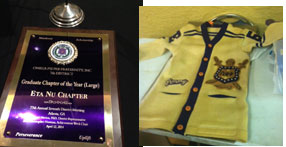
The event culminated with Basileus Brihm presenting a plaque on Eta Nu’s behalf to President Carnell Smith who accepted on behalf of the Highwaymen. I encourage anyone with a passion for art to learn more about these magnificent artists and their portraits.