

The killings began in 1979, just two years after the infamous Son of Sam murders in New York had commanded the nation’s attention. In the end, 29 victims, including 22 children, had been killed. Two victims were girls, six were adult men, and 21 were boys. All of them were Black, nearly all were from low-income families, and each was beaten and strangled.
By Stacy M. Brown, NNPA Newswire Senior National Correspondent@StacyBrownMedia
More than 40 years ago, the Atlanta Child Murders case rocked the nation, bringing the city to a scary standstill.
The killings began in 1979, just two years after the infamous Son of Sam murders in New York had commanded the nation’s attention.
In the end, 29 victims, including 22 children, had been killed.
Two victims were girls, six were adult men, and 21 were boys.
All of them were Black, nearly all were from low-income families, and each was beaten and strangled.
Wayne Williams, a freelance photographer, has served 41 years after being convicted of murdering two of the adult victims.
Authorities closed the case with a strong belief that Williams killed all 29.
Last year, former Mayor Keisha Lance Bottoms ordered authorities to reopen the case, and the city’s police department extracted two DNA samples which they sent to a facility in Utah for testing.
The results still haven’t been released, and Williams’ new attorney, Janis Mann, said answers are hard to achieve.
“We have absolutely no evidence as to what has been uncovered,” she told an Atlanta television station.
“I asked the city, Atlanta Police, and the District Attorney’s office about the samples, and they told me so far, no official report is available.”
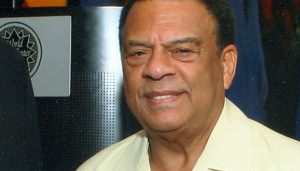
And while Williams and the victims’ families await word, former U.S. Ambassador and ex-Atlanta Mayor Andrew Young offered some observations.
Young served as mayor for two terms beginning on Jan. 4, 1982.
His swearing-in occurred just eight months after the final victim, 27-year-old Nathaniel Cater, was killed and only two days before Williams’ criminal trial began.
On Feb. 27, 1982, after deliberating for 12 hours, a jury found Williams guilty of murdering Cater and 21-year-old Jimmy Payne.
While not charged with the other murders, investigators concluded that Williams was responsible for all the killings.
Judge Clarence Cooper sentenced Williams to life behind bars.
“I knew the boy they arrested,” Young said of Williams during an exclusive interview.
“I had known [Williams] since he was 12 or 13.”
Young said he met a young Wayne Williams during his run for Congress at the beginning of the 1970s, or less than a decade before the first murder.
“I went to his school, and he came up to me while he was in the eighth grade and asked if he could interview me,” Young recalled.
He said Williams had built a radio station in his home that earned him a science prize at school.
“He told me his house was right across the street,” Young remembered.
After some back and forth over logistics, including whether such an interview would disturb Williams’ elderly parents, Young agreed to the sit-down.
He said he recalled the makeshift station being “illegal.”
Still, because Williams was a child who had won an award for his invention, authorities didn’t view the station as problematic until later when Williams did other “illegal” things.
“The room had a separate entrance around the back,” Young recalled.
“He set up a card table and placed a microphone between him and me, and two other people were in the room for the interview. I had realized that his parents, who were teachers, didn’t know about the setup.”
Young later surmised that Williams had operated from that space for “quite some time.”
During the child murders’ investigation, Young acknowledged that he remained on the sidelines as he ran for mayor.
“I didn’t say anything, but there were things that made me think he could do this,” Young insisted.
“I remember one of the city council members who knew him well said she was at his house when he was still in high school. Wayne’s dad was about six-feet-one or six-feet-two, and [Williams] knocked his daddy down on the couch and sat on him. He went through his pockets, took his keys, and said, ‘I told you I was going to use the car tonight.’”
Young said Williams “was on his own” because his parents were senior citizens.
Tellingly, he said he believed Williams capable of murder.
“I know the bridge where they found a body,” Young asserted. “That was all reasonable.”
Finally, he noted his confidence in the investigation despite rampant rumors suggesting involvement by the Ku Klux Klan or law enforcement.
“You had a Black police commissioner and a Black police chief,” Young stated.
“Then you have two mayors, and all of us had children like the child victims, who were all between 10 and 15. So, yes, I think [William
