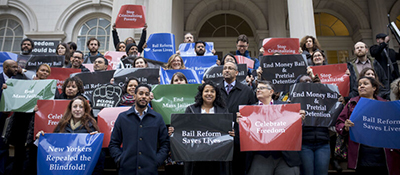
With hundreds of thousands of individuals locked up in jails almost daily, many find it challenging to pay bail.
By Stacy M. Brown, NNPA Newswire Senior National Correspondent@StacyBrownMedia
As public support for criminal justice reform continues to build — and as the pandemic raises the stakes higher — advocates remain vigilant that it’s more important than ever that the facts are straight, and everyone understands the bigger picture.
“The U.S. doesn’t have one ‘criminal justice system;’ instead, we have thousands of federal, state, local, and tribal systems,” Wendy Sawyer and Peter Wagner found in a study released by the nonprofit Prison Policy Initiative.
“Together, these systems hold almost 2 million people in 1,566 state prisons, 102 federal prisons, 2,850 local jails, 1,510 juvenile correctional facilities, 186 immigration detention facilities, and 82 Indian country jails, as well as in military prisons, civil commitment centers, state psychiatric hospitals, and prisons in the U.S. territories,” the study authors discovered.
With hundreds of thousands of individuals locked up in jails almost daily, many find it challenging to pay bail.
Recognizing America’s ongoing mass incarceration problem and the difficulties families have in bailing out their loved ones, a new organization began in 2018 to offer some relief.
The Bail Project, a nationwide charitable fund for pretrial defendants, started with a vision of combating mass incarceration by disrupting the money bail system.
Adrienne Johnson, the regional director for The Bail Project, told NNPA’s Let It Be Known that the organization seeks to accomplish its mission one person at a time.
“We have a mission of doing exactly what we hope our criminal system would do: protect the presumption of innocence, reunite families, and challenge a system that we know can criminalize poverty,” Johnson stated.
“Our mission is to end cash bail and create a more just, equitable, and humane pretrial system,” she insisted.
Johnson said The Bronx Freedom Fund, at the time a new revolving bail fund that launched in New York, planted the seed for The Bail Project more than a decade ago.
“Because bail is returned at the end of a case, we can build a sustainable revolving fund where philanthropic dollars can be used several times per year, maximizing the impact of every contribution,” Johnson stated.
In addition to posting bail at no cost to the person or their family, The Bail Project works to connect its clients to social services and community resources based on an individual’s identified needs, including substance use treatment, mental health support, stable housing, and employment.
Johnson noted that officials created cash bail to incentivize people to return to court.
Instead, she said, judges routinely set cash bail well beyond most people’s ability to afford it, resulting in thousands of legally innocent people incarcerated while they await court dates.
According to The Bail Project, Black Americans are disproportionately impacted by cash bail, and of all Black Americans in jail in the U.S., nearly half are from southern prisons.
“There is no way to do the work of advancing pretrial reform without addressing the harmful effects of cash bail in the South,” said Robin Steinberg, Founder, and CEO of The Bail Project.
“Cash bail fuels racial and economic disparities in our legal system, and we look forward to supporting the community in Greenville as we work to eliminate cash bail and put ourselves out of business.”
Since its launch, The Bail Project has stationed teams in more than 25 cities, posting bail for more than 18,000 people nationwide.
Johnson said the organization uses its national revolving bail fund, powered by individual donations, to pay bail.
The Bail Project has spent over $47 million on bail.
“When we post bail for a person, we post the full cash amount at court,” Johnson stated.
“Upon resolution of the case, the money returns to whoever posted. So, if I posted $5,000 to bail someone out, we then help the person get back to court and resolve the case,” she continued.
“The money then comes back to us, and we can use that money to help someone else. So, we recycle that.”
Johnson said eliminating cash bail and the need for bail funds remains the goal.
“It’s the just thing to do. It restores the presumption of innocence, and it restores families,” Johnson asserted.