By Dr. Glenn Altschuler
(Source Florida Courier):
BOOK REVIEW
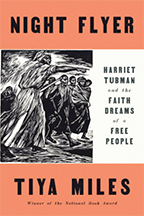
“Night Flyer: Harriet Tubman and the Faith Dreams of a Free People,” by Tiya Miles. Penguin Press, 336 pp. $30.
Araminta Green-Ross’s first memories involved lying in a wooden cradle, probably carved by her father. According to Tiya Miles, it may well have been the only space of physical safety and emotional security the enslaved child would know until she was a young adult.
As a toddler, “Minty” was no longer watched, comforted, or instructed by her parents, who worked from dawn until well past dusk and slept elsewhere on plantations on Maryland’s Eastern Shore. At age six, Minty was leased out to a different white family.
When two of her sisters were sold and carried away on a chain gang, she witnessed the grief of her mother and despair of her father and began to ask, “Why should such things be?”
When she married John Tubman, Minty called herself Harriet, her mother’s first name. She escaped to Philadelphia, returned to the South to rescue at least 70 people, including family and friends, resettled many of them in Canada, and subsequently served as a scout and spy for the Union Army during the Civil War.
Celebrated these days as the most famous Black woman in U.S. history, Tubman will soon replace Andrew Jackson on the $20 bill.
In “Night Flyer: Harriet Tubman and the Faith Dreams of a Free People,” Tiya Miles—a professor of history at Harvard University and MacArthur Fellowship recipient—draws on a plethora of sources, such as newspaper accounts, dictated letters and the experiences of enslaved women in an elegant, evocative, and empathetic account of Harriet Tubman’s “faith journey.”
According to Miles, when Minty was about 13 years old, a 2-pound iron weight thrown by an overseer at a young slave hit her instead, breaking her skull. The religious state she achieved following the injury, from which she never fully recovered, left her with a “skintight intimacy with God,” headaches, strange sleep patterns, spurts of energy and lethargy, an amplified, second or future sight, and mysterious gifts.
She came to believe that God, with whom she talked every day, had heard her call to free those she called “her people” from the hell of slavery. Also, she believed that the will of God dovetailed with the doctrine of natural rights enshrined in the founding documents of the United States.
To reassure runaway slaves, Tubman often recited psalms and sang songs: 10,000 angels “are always hovering round you, Till you reach the heavenly land.” Despite the desolation of their location, the desperation of their situation, and Tubman’s manifest physical ailments, Miles speculates, “they must have believed her, or wanted to… After all, God could uplift the weak and imbue them with secret strengths.”
Reliance on nature
Tubman’s knowledge of and reliance on nature, Miles suggests, was second only to her faith in God, “and seemed at times to be fused with it.” She had an uncanny sense of when and how to hide behind trees, in “potato holes” and swamps. And when to coax runaways to walk into rising streams.
Tubman’s tool kit also included reliable information, social connections along the road to freedom, money and material.
Tubman hired people to take down notices for escaped slaves soon after they were posted. She attempted rescues in the winter, when the nights are long and dark, and people stay in their homes.
During the Combahee River Raid in South Carolina, in which 750 individuals were liberated, her Civil War scouting service and spy ring tapped the expertise of self-emancipated Blacks who knew the terrain, could travel undetected and pinpoint Confederate positions.
Tubman risked lives, at times recklessly, Miles acknowledges, to protect the group. She told mothers to keep their babies quiet by drugging them with substances that could cause overdoses or even death. Always carrying a gun, she threatened to shoot runaways who got scared and tried to turn back.
That said, Tubman was at least as harsh and unforgiving toward herself. A willing martyr, she declared that when the time had come, “the Lord will let them kill me.”
“Harriet knew the North Star,” an associate recalled, “that was one thing she insisted she was always sure of.” And, as Tubman herself was wont to say, “Every goodbye ain’t gone.”
Dr. Glenn C. Altschuler is the Thomas and Dorothy Litwin Emeritus Professor of American Studies at Cornell University.