
 By ReShonda Tate, Defender Network
(Source: Miami Times)
For years, Black women have been told to work twice as hard to get half as far. In 2025, many discovered that even excellence was no protection from layoffs.
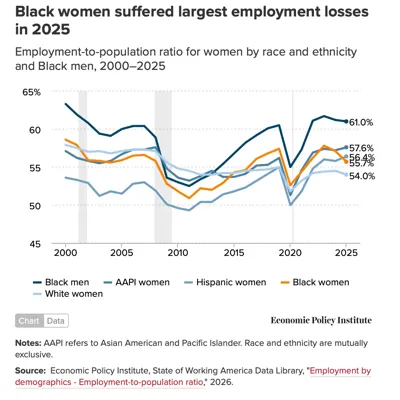
As corporations scaled back Diversity, Equity and Inclusion initiatives and government agencies faced sweeping cuts, Black women were among the hardest hit. Between spring and late 2025, more than 300,000 Black women either lost jobs, left the workforce or were pushed out of employment, according to labor data and economic reports tracking the crisis. Unemployment among Black women climbed from 5.4% to as high as 7.3% by the end of the year — one of the steepest increases of any demographic group.
Many of those losses occurred in sectors where Black women have historically found opportunity and stability: government, higher education, human resources, nonprofit leadership and DEI-focused roles.
But instead of retreating, many are rebuilding.
Across the nation, Black women are launching consulting firms, wellness brands, coaching businesses, creative agencies and online enterprises — transforming professional rejection into economic reinvention.
“What we are witnessing is both painful and powerful,” said Mary-Frances Winters, founder of The Winters Group and a longtime diversity strategist. “Black women are disproportionately impacted by systemic inequities in the workplace, but they are also uniquely equipped to innovate because they’ve spent their entire careers learning how to navigate instability.”
For many women, the layoffs did more than disrupt finances. They reopened emotional wounds tied to years of workplace discrimination, isolation and burnout.
That reality is what pushed attorney and author Brittany Wardlawto finally tell her story.
Wardlow left her position at Baylor University in Texas in 2020 after what she describes as years of enduring a psychologically damaging corporate and institutional environment. In her book, My Untold Stories: The Roads that Led to Liberation, she details the emotional toll of navigating racist workplace dynamics while trying to preserve her mental health and sense of self.
“It was really traumatic to my mental health,” Wardlow said. “And it wasn’t until I was able to walk away that I realized how much I had lived through and how my story is not unique.”
Wardlow said many Black professionals remain silent because speaking up can come with consequences.
“We don’t get to tell it,” she said. “One, because we may take an NDA so that we don’t say anything about what happened while we were there. Or we don’t want to be blackballed professionally. So we just kind of grin and bear it.”
Her departure from Baylor was public — and controversial.
“I made a heavy and very unpopular decision to walk away from my employment at Baylor University in a very public way,” Wardlow said. “I left loudly.”
She said she had watched Black and Brown professionals “suffer psychologically in silence because they felt they had too much to lose — their livelihood, their community, their sanity.”
The decision to leave, she said, was rooted in faith.
“Gary (her husband) and I made a faith-saturated decision to walk away and risk losing it all,” she said.
Since then, Wardlow has spent years healing, rebuilding and reclaiming her voice through writing, speaking and entrepreneurship.
“In this book, I talk about the why, as well as the what,” she said. “And all the beauty that has bloomed from the ashes for me and my family.”
Her story mirrors what many Black women say they experience in corporate America: the pressure to survive environments that often feel hostile, isolating or emotionally unsafe.
“We figure out how to make it through, and we push on to the next racially traumatic corporate environment,” Wardlow said. “And so when I left, I said, ‘No, I’m going to tell the story. I’m going to let people know that this is the playbook. This is what happens. This is how you can navigate it. This is how I came out on the other side.’”
For Denise Aguilar, another woman navigating reinvention after layoffs, entrepreneurship became both a financial and emotional reset.
“I had spent years helping companies fix culture issues, support employees and create inclusive systems,” Aguilar said. “Then suddenly those roles became ‘nonessential.’ That told me all I needed to know.”
Instead of searching endlessly for another corporate role, Aguilar launched her own consulting business focused on leadership development and workplace culture.
“I stopped asking for permission to lead,” she said. “That changed everything.”
Experts say stories like Aguilar’s and Wardlow’s reflect a nationwide shift.
Black women already represent one of the fastest-growing groups of entrepreneurs in America, with businesses spanning consulting, wellness, beauty, technology, education, media and e-commerce. Economists say that growth is increasingly tied to necessity as many women seek stability outside traditional corporate systems.
“There’s a growing realization that ownership matters,” Winters said. “Black women are recognizing that building something for themselves may offer more long-term stability than depending on systems that historically have not protected them.”
Still, experts caution that entrepreneurship born from necessity often comes with emotional strain.
Many Black women entering business ownership are doing so while managing burnout, caregiving responsibilities, financial uncertainty and the lingering psychological effects of workplace discrimination.
“There’s grief attached to these transitions,” Winters said. “People celebrate the entrepreneurship story without acknowledging the pain that preceded it.”
Community support has become one of the most critical tools helping Black women navigate reinvention. Across social media and professional circles, Black women are forming consulting collectives, accountability groups, investment circles and global support networks, such as Black Pax Group, to help women share resources, opportunities and strategies for survival.
“These networks matter because many Black women don’t have generational safety nets,” Winters said. “Community becomes the bridge.”
For Wardlaw, the biggest lesson from her journey is understanding that success does not have to be tied to corporate validation.
“We’ve been conditioned to think that we can only be successful if we’re working for somebody,” she said. “But the reality is we have everything we need to be successful on our own.”
She hopes Black women understand they have options.
“If you want to be part of an organization and bring what you have to make them great, awesome,” she said. “But you have what you need to be great in and of yourself.”