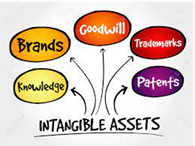
Intangible assets have long existed — rights such as copyrights, leases and government subsidies — but other electronic properties are gaining recognition, too. Intangibles run a wide spectrum, from patents and trademarks to less visible concepts like culture and networking or to even more latent infrastructure, such as industry protocols, standards or trusts.
Examples include:
Brand names.
Internet domains and social media presences.
Noncompetition and employment agreements.
Computer software.
Trade secrets and recipes processes.
Customer lists.
Order backlogs.
Licenses, leases and royalties.
Government grants.
The art of valuation
In general, if a company derives much of its value from intangible assets, it typically warrants a higher discount rate and a more conservative approach. One drawback of discount rate analysis is that it is easy to manipulate to arrive at the required valuation. Compounding the dilemma, even slight adjustments have amplified ramifications. Think of it like the Hubble telescope — move it a quarter of an inch, and you’re in a different galaxy.
A decision to increase or decrease the discount rate may come down to idiosyncratic factors. Patents, for example, provide differing levels of protection, depending on their remaining term. A longer remaining life could increase the discounted cash flow. By contrast, that same patent might actually lead you to reduce your estimated cash flow if it were nearing expiration. How many years does it have left to run, what’s the nature of the competitive landscape, and does a firm’s process generate additional patents over time?
Interpreting goodwill
Goodwill is exceptionally difficult to evaluate. Assets like trademarks, patents or customer lists are somewhat easier to pin down, but goodwill is vulnerable to manipulation.
Some companies are organically driven and may not even utilize a line item for goodwill. Others, during an aggressive growth mode, might lump many components of goodwill together. Coca-Cola is often cited as exemplifying how organic goodwill can be worth billions of dollars, vastly more than the rest of a company’s assets. Coca-Cola’s product consists of water, corn syrup and flavoring, but the company has tremendous brand and secret-recipe value.
What is the underlying reason for the existence of a particular item of goodwill? Is it relevant to longer-term business exposures and strategies? Does that goodwill help a firm establish a position or become more involved in trends driving the global economy? At the crux, is it more economical to buy a new business line of activities or to create it in-house?
Current accounting rules call for a rapid write-down for any impairment of that elusive goodwill balance sheet entry. In simple terms, goodwill represents the excess amount an acquirer is willing to pay over the fair value of a unit — the price that would be received in an orderly transaction between market participants. Yet analysts struggle mightily with impairments.
For any acquisition, the purchase price only applies to Day 1. The slope gets slipperier for a nonfinite asset with no expiration, like a trademark. Rather than amortizing and writing down these assets over time, companies must retest them annually. The technology may even become obsolete, in which case that entire investment should theoretically be written down to zero. But management would then have to admit a huge mistake. Few are eager to do so!
It can happen, however. Goodwill sometimes provides justification for the price of an acquisition. For example, Warren Buffett wrote down the value of the Kraft and Oscar Mayer brands inside the Kraft Heinz Company. The company concluded it had overpaid in goodwill when Heinz acquired the Kraft name. Although relatively little had changed, the company considered it imprudent to carry those brand values at overstated valuations.
A new outlook
Older gauges may not adequately capture today’s business themes: the compression of time, technological change, enhanced communications, globalization and network effects. None of these concepts are easy to operationalize in concrete corporate terms. As investments shift in emphasis toward ideas and relationships, investors may want to take into account the role of intangible elements in their portfolio holdings.
For a deeper dive into the role and weight of intangibles among your own investments, ask your financial adviser how these features may be reflected in your asset lineup.