

A few regulars returned to Café Vrindavan, in an eastern suburb of Mumbai as soon as it reopened on Oct. 5, but it remains to be seen how quickly restaurants can recover from the lockdown due to the pandemic. Restaurants have been closed for indoor dining since March.
“The business was slow,” said Ashwin Shetty, the cafe’s owner. “But people were happy to come in. I received a mixed crowd of my regular customers as well as new ones.”
The government of Maharashtra, a state in western India that includes Mumbai, gave permission for restaurants to open, but with a specific list of safety procedures, including: operating at 33 percent seating capacity, and measures outlining sanitization, digitization of menus and payment if possible, and recording customers’ contact details.
Adarsh Shetty, past president of the Indian Hotel and Restaurant Association and now an adviser to the organization, said that only 30 percent of restaurants in Mumbai, mainly small eateries and quick-service outlets, are open for dining-in.
“There is a severe manpower shortage as most staff are yet to return from their hometowns,” said Shetty. “The government circular was not clear on whether the alcohol-serving restaurants could start services. Due to the lack of clarity, many such restaurants delayed their opening.
“With all these issues, only 30 percent of the restaurants could open, and that, too, with very limited staff. Hopefully, more eateries will open in the coming days.”
Some customers protested entering contact details. While sharing contact details in fine-dining restaurants is common for reservations, smaller eateries and quick-service restaurants never had such norms.
“Not everyone likes sharing contact details just to grab a quick bite,” said Shetty. “It feels like a breach of privacy to them. Some people, mainly couples, were not comfortable sharing their names and contact information. A few customers walked out as well as they did not like this norm. But it is a government rule. This information is mandatory for contact tracing and all restaurants will follow it strictly.”
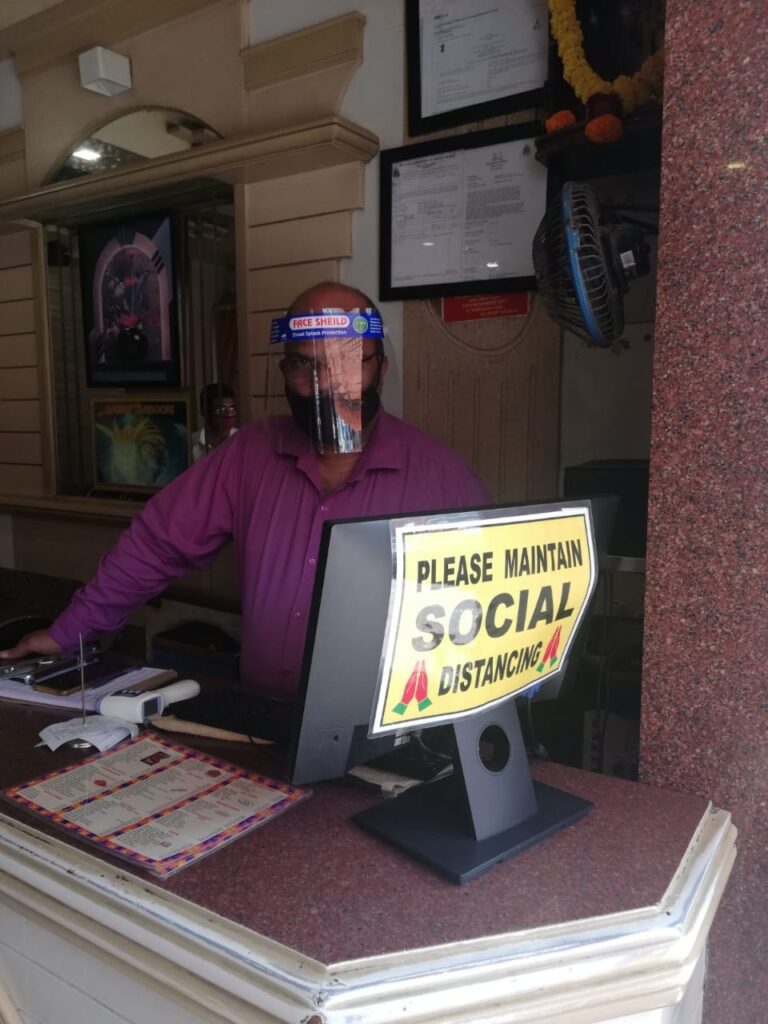
The limits on reopening also present financial issues for restaurants.
“With only 33 percent seating allowed, we are directly losing the remaining 67 percent of business,” said Suryakant Sarjoshi, owner of Aaswad, a popular restaurant in Dadar in central Mumbai. “But the operating costs will remain the same.”
Aaswad will open in another eight to 10 days for dine-in services. The restaurant is putting in place many changes, including a touchless menu that allows customers to scan a QR code to place orders and make payments. Its staff, like all restaurant workers in the city, are required to wear masks and follow hygiene protocols. Tables will be sanitized for every customer.
“Commute for our staff is a big concern right now,” said Sarjoshi. “Many of our staff live in far-off suburbs, nearly 40 kilometers (about 25 miles) away from the restaurant. The suburban train services are yet to resume. Without the trains, it is impossible for the staff to travel such distances.”
Mumbai’s local train services are currently running only for essential workers such as health care staff and police. Train travel is barred for the general public.
“Starting restaurants in full swing is impossible if the train services are not resumed fully,” said Ramesh Shetty, owner of Modern Lunch Home, a restaurant in the western suburb of Andheri.
“We have only five staff members including two waiters. The remaining staff will resume, but their daily commute is a major concern.”
A report by the National Restaurant Association of India states that the restaurant industry employed 7.3 million people in 2018-19, and estimated the food service industry’s market size at INR 423,865 crore ($57 billion) in 2018-19. At the time of the report in May 2019, well before the pandemic, it forecast that the industry was expected to expand to INR 599,782 crore ($81 billion) by 2022-23.
“The food service industry is evolving rapidly with India being the youngest country with internet and tech-savvy consumer base, having a high disposable income with little time to cook indoors,” the report states.
“It is great to have restaurants back,” said 61-year-old Atul Shukla, an alternative medicine practitioner who was among the first customers of Cafe Vrindavan on Oct 5. “I got to eat my favorite masala dosa (a south Indian dish) and lassi (a curd-based drink) after so many months.”
Shukla said he did not worry about the coronavirus when deciding to dine in a restaurant.
“There was enough distance between tables,” he said. “All the staff was wearing masks. They also checked temperature and oxygen saturation of every customer walking in.”
The pandemic continues unabated in the country, with more than 6 million cases and more than 100,000 deaths recorded. Mumbai, the country’s financial capital, has recorded over 200,000 cases and more than 9,100 deaths.
(Edited by Siddharthya Roy and Judy Isacoff.)
The post Indian Restaurants Cautiously Reopen For Dining-In After 6 Months appeared first on Zenger News.
