Is there a link between housing policy and violence?
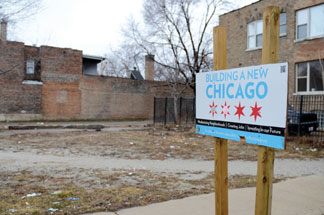
Empty lots and boarded-up homes are a common sight on the Southside of Chicago, where many former residents of high-rise projects moved after the building were demolished by the city. (Photo: Marketplace Wealth and Poverty Desk)
By Sylvester Monroe
CHICAGO, ILL – Most people agree that high-rise housing projects in Chicago like Cabrini Green needed to be demolished. But the neighborhoods where many of the former project residents ended up often weren’t much better than the projects themselves. Moving project residents into new neighborhoods created tensions with established residents and that sometimes led to violence. In fact, some say public housing policy is one of the causes of violence in some poor Chicago neighborhoods.
Jamika Smith lives in a Chicago-style bungalow with her husband and baby daughter on the South Side of the city. But she grew up in a housing project on the city’s West Side. As she recalls, it was not such a bad life.
“You could leave your doors open,” Smith says. “Everyone knew each other, and it was just this close-knit community.”
But it didn’t stay idyllic for long. Soon drugs moved in, and upstanding residents moved out. And life got tougher.
“We were just like, oh, they’re hanging out on the corners now,” says Smith. “All of a sudden, you just see the rise of violence in the community. And people just could not walk up and down the streets because they’d get shot.”
Smith moved out of the projects, went to college in Tennessee and eventually ended up in Marquette Park on the Southwest Side – just in time to greet an influx of residents relocated from demolished housing projects all over the city, many with competing gang affiliations.
“For example, you may have been “Cabrini Green”, that’s one gang,” says Smith. “And then you have the “Horners”, who are another. And you put them all in one community area. Then you have war.”
Such violence has now found its way to Smith’s current neighborhood. Yellow police tape near a blood spot on the pavement marks the area where a 17-year-old boy was shot five times, just blocks away from Jamika Smith’s house.
Chicago is in fact something of a war zone today. More people were killed in the city last year than U.S. soldiers in Afghanistan. But did tearing down the projects cause the recent explosion in violence?
“I think the good news is that after we tore the high rises down, we moved thousands of families into other areas of the city and that crime was reduced I think as much as 60 percent at transformation sites,” says Charles Woodyard, CEO of the Chicago Housing Authority.
By transformation sites, Woodyard means places where the high-rises once stood.
Woodyard also says that crime didn’t go up in most of the neighborhoods where former project residents moved. “There were a handful of exceptions, though, and it’s all about concentration,” he says. “What I mean by that is the number of these relocated households compared to the number of house-holds in the neighborhood that they live in.”
Put another way, if too many people from the projects ended up in one neighborhood, there was trouble.
But Susan Popkin of the Urban Institute warns against oversimplifying the violence problem in neighborhoods where former project residents now use rent vouchers. “The Section 8 [voucher] holders tend to move to places where rents are low already and crime is already high,” Popkin says.
They went from poor, violent high-rises to poor, violent neighborhoods that already had problems. Popkin says that did have some effect on the crime rate. Violence was down in 2010, but it would have been down even more in certain neighborhoods if not for the arrival of former project residents. “So I’m not saying there was no effect at all. What I’m saying is that it’s not nearly as big as people think it is,” says Popkin.
She says that factors like concentrated poverty and the foreclosure crisis shoulder a far larger share of the blame for violence in Chicago. “You have a situation where you have extremely poor people who have a lot of problems all living in one place, and you get a situation that’s not healthy,” she says.
Wentworth Gardens is a low-rise housing project on the South Side. Many residents are people relocated from other projects across the city.
On the third floor of one of the buildings, Reggie Lee Ricks is doing word puzzles at his mother’s kitchen table. His family was the last to leave the infamous Cabrini Green housing project. They were not happy about the move.
“The neighborhood we moved out of, at least we knew everybody,” says Ricks. “You couldn’t get touched. Over here, you can get touched.”
Moving to Wentworth was supposed to be better for Ricks and his family. But he and his brothers were hassled by gangs that didn’t know them, and his mother Annie constantly worries about their safety.
“It’s pretty much the same,” says Ricks, 22. “Wherever, you go, it’s going to be the same. People still out here killing each other.”
In fact, for people like Ricks, poverty and violence go hand-in-hand in Chicago. “If everybody had a mansion, don’t you think everybody’d be more happy?” he asks. “But they say money don’t make you happy.”
He says step one is fixing how people live. Maybe then, it wouldn’t matter where you ended up.