 Julius Rosenwald, Jewish philanthropist, partnered in African American education
By Nelson Underdue
Award-winning filmmaker Aviva Kempner’s documentary, Rosenwald was chosen to screen at the 106th NAACP National Convention in Philadelphia on July 14.
“If you want to lift yourself up, lift up someone else.” Booker T. Washington’s words resonated with many, but perhaps none more than Julius Rosenwald, the subject of a new documentary by award winning filmmaker Aviva Kempner.
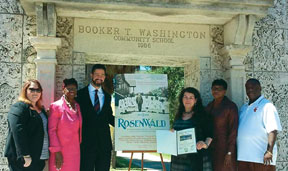
Kempner went to Booker T. Washington High School in the Overtown section of Miami to discuss the film with students last week.
Film subject Julius Rosenwald was an early supporter of the NAACP. Rosenwald is the incredible story of Julius Rosenwald, who never finished high school, but rose to become the President of Sears. Influenced by the writings of the educator Booker T. Washington, this Jewish philanthropist joined forces with African American communities during the Jim Crow South to build over 5,300 schools during the early part of the 20th century.
Kempner led a panel discussion in Booker T. Washing-ton’s famed planetarium. Clips of Rosenwald, Kempner’s film, were shown throughout the presentation as she explained the works of the man that inspired her work.
“He was a northerner; he was from Chicago. He didn’t finish high school, I do NOT recommend you do that” Kempner joked to the students in attendance. “but it’s ironic that he went on to become such a great teacher.”
Julius Rosenwald amassed a fortune in the early 1900’s through his partnership with Sears Roebuck and Company. Throughout his lifetime, Rosenwald is said to have given away at least $62 million of his own money through philanthropic efforts like building schools all over the south, even helping to fund Booker T. Washington’s Tuskegee Institute, the training facility for Black Army Pilots during World War Two.
“Rosenwald thought it was very important to help Black people. Especially in the rural south where it was so tough. He and Booker T. Washington were very close.” Kempner explained.
Thursday’s panel also included Miami-Dade County Commissioner of District 3, Audrey Edmonson, Rabbi Marc Labowitz of the South Florida Center for Jewish Renewal, and Dr. Shirley Johnson, the newly inducted president of the NAACP of Miami-Dade.
“We’ve come a long way”, Dr. Johnson recalled “Black students are now in a position where they can insist that they be taught about more lesser known figures in history, but they must take advantage of it.”
Select students were given an opportunity to watch Rosenwald on the silver screen. On Friday, students were treated to a private screening of Rosenwald at the AMC Aventura Theaters. “This is a great opportunity for our students to learn about the history of the civil rights struggle from another perspective” said William Aristide, the Principal of Booker T. Washington High School.
Rosenwald sheds light on this silent partner of the Pre-Civil Rights Movement. Julius Rosenwald awarded fellowship grants to a who’s who of African American intellectuals and artists including: Marian Anderson, James Baldwin, the father and uncle of civil rights leader Julian Bond, Ralph Bunche, W. E. B. DuBois, Katherine Dunham, Ralph Elli-son, Langston Hughes, Zora Neale Hurston, Gordon Parks, Jacob Lawrence and Augusta Savage along with Woody Guthrie.
The list of prominent alumni and educators who attended the Rosenwald Schools include the ancestors of Loretta Lynch (US Attorney General), Tony Award winning playwright George Wolfe, poet Maya Angelou, U.S. Representative John Lewis, Anita Hill and Pulitzer Prize winner Eugene Robinson.
“A third of his money was for spending, a third was for saving, and the other third he would give away” Kempner explained. “But it’s not just about the money. I think one of the best lessons that Rosenwald taught us is that anyone can give. Give our money, give our time, or give ourselves to those in need.”