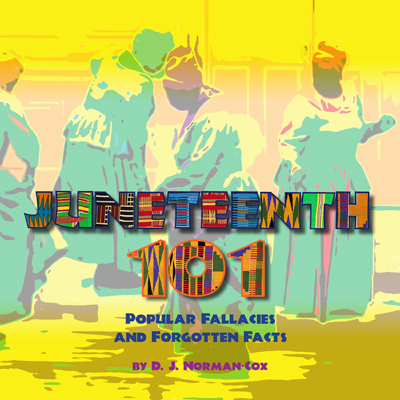
Texan launches effort to correct entrenched myths about the holiday
DENTON, TX. May 16, 2018 – Donald Norman-Cox, a 64 year old resident of Denton, Texas has a message for the nation regarding Juneteenth: “Tell it right or stop talking.” Since the mid-2000s, Mr. Norman-Cox has sporadically informed college and community groups that parts of the Juneteenth explanation are flagrantly wrong. This year, his message has muscle.
“Every explanation I’ve heard since childhood made little sense,” Norman-Cox said. But like many others, he never bothered to search for facts. “I wondered how news of the proclamation could travel to Europe faster than it floated across the states. How did news reach what is now New Mexico without going through Texas? When did other states free their slaves?”
Those quandaries and more are addressed in Norman-Cox’s new book Juneteenth 101. The book debunks several widely held myths about Juneteenth, including its primary tenet: news of the Proclamation didn’t reach Texas for two and a half years. “You hear that everywhere, but it’s wrong,” Norman-Cox said. “Delayed emancipation was not caused by not-knowing. The culprit was lack of enforcement.”
Cox admits to holding a near life-long hope that others had researched their explanations. “I challenged nothing,” he laughs, “until one question refused to be ignored.” That question was why do Texans commemorate both Watchnight and Juneteenth?
Watchnight was the night slaves held vigils to watch for freedom, courtesy of the Emancipation Proclamation. Juneteenth occurred supposedly because no one knew the Proclamation existed. Cox said, “Those opposing explanations coexist peacefully only in minds of the oblivious.”
While digging for clarification, Norman-Cox discovered some Texans knew about the Emancipation Proclamation before it was issued. “On September 15, 1862, a newspaper in tiny Clarksville, Texas reported Lincoln was about to issue ‘a proclamation of general universal emancipation’. Nine days later, Lincoln issued his preliminary proclamation. What little guys knew, the big ones did, too.”
That and other discoveries are packed in a new book titled Juneteenth 101.
Norman-Cox calls his findings, “Earth shaking, but nothing new.” He said, “Professional historians – which I’m not – have known these facts probably since emancipation became a topic worthy of scholarly examination. This book translates existing academic discourse into street speak … to help Big Mama and Ray-Ray ‘nem not be wrong.”
Juneteenth 101 claims incorrect explanations oversimplify the complex and chaotic way slavery ended. Believing slavery continued because they didn’t know, misidentifies ‘they’.
“They” refers to slave owners,” Norman-Cox contends. “What slaves knew was irrelevant. Their walking off the job is called running away, not emancipation.”
According to Norman-Cox, Juneteenth falsehoods are pervasive. Even Congress incorrectly refers to Juneteenth as “the day slavery ended in the United States”. Juneteenth 101 identifies 31 congressional resolutions that include or were defended by that statement. “As if six months later, the Thirteenth Amendment did nothing,” Cox added.
To replace that inaccuracy the book offers this explanation, “Juneteenth celebrates the end of slavery; not the day slavery ended.”