
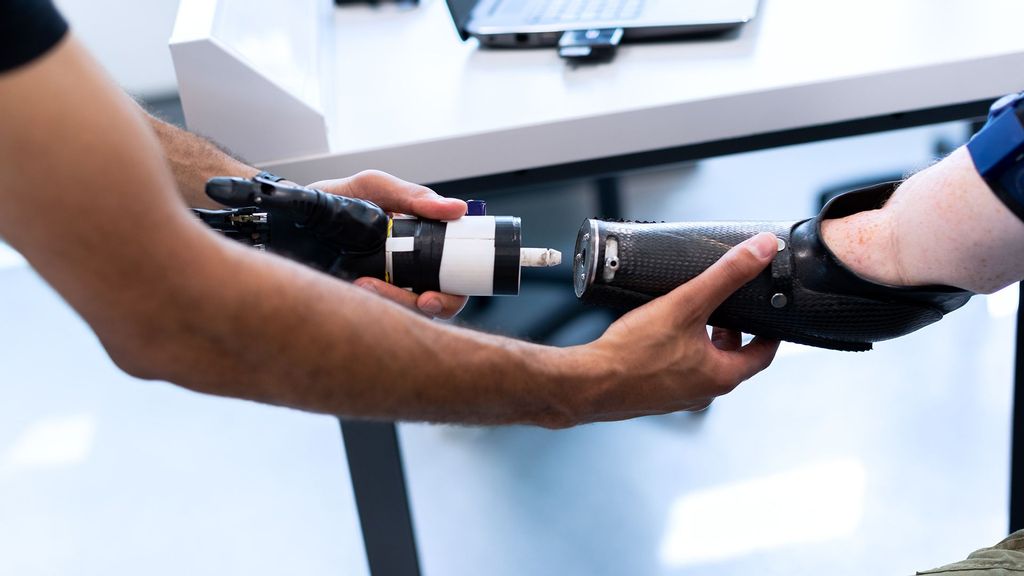
WASHINGTON — Researchers at the Massachusetts Institute of Technology have developed a new strategy that could offer much more precise control of prosthetic limbs. After inserting tiny magnetic beads into muscle tissue, they can accurately measure the length of a muscle as it contracts. This measurement can be relayed to a robotic prosthesis within milliseconds.
In a new study, “Magnetomicrometry,” appearing in the journal “Science Robotics,” the researchers tested their new strategy, called Magnetomicrometry (MM), and showed that it could provide fast and accurate muscle measurements in animals. They hope to try the approach in people with amputation within the next few years.
“Our hope is that MM will replace electromyography as the dominant way to link the peripheral nervous system to bionic limbs. And we have that hope because of the high signal quality that we get from MM, and the fact that it’s minimally invasive and has a low regulatory hurdle and cost,” said Hugh Herr, senior author of the study, a professor of media arts and sciences, head of the Biomechatronics Group in the Media Lab.
Cameron Taylor, an MIT postdoc, is another author of the study. Other authors include MIT postdoc Shriya Srinivasan, MIT graduate student Seong Ho Yeon, Brown University professor of ecology and evolutionary biology Thomas Roberts, and Brown postdoc Mary Kate O’Donnell.
With existing prosthetic devices, electrical measurements of a person’s muscles are obtained using electrodes that can be either attached to the skin’s surface or surgically implanted in the muscle. The latter procedure is highly invasive and costly but provides somewhat more accurate measurements. However, in either case, electromyography (EMG) offers information only about muscles’ electrical activity, not their length or speed.
“When you use control based on EMG, you’re looking at an intermediate signal. You’re seeing what the brain is telling the muscle to do, but not what the muscle is actually doing,” said Taylor.
The new MIT strategy is based on the idea that if sensors could measure what muscles are doing, those measurements would offer more precise control of a prosthesis. To achieve that, the researchers decided to insert pairs of magnets into muscles. By measuring how the magnets move relative to one another, the researchers can calculate how much the muscles are contracting and contraction speed.
Two years ago, Herr and Taylor developed an algorithm that significantly reduced the time needed for sensors to determine the positions of small magnets embedded in the body. This helped them to overcome one of the significant hurdles to using MM to control prostheses, which was the long lag-time for such measurements.
The researchers tested their algorithm’s ability to track magnets inserted in the calf muscles of turkeys. The magnetic beads they used were 3 millimeters in diameter and were inserted at least 3 centimeters apart — if they are closer than that, the magnets tend to migrate toward each other.
Using an array of magnetic sensors placed on the outside of the legs, the researchers found that they were able to determine the position of the magnets with a precision of 37 microns (about the width of a human hair) as they moved the turkeys’ ankle joints. These measurements could be obtained within three milliseconds.
To control a prosthetic limb, these measurements could be fed into a computer model that predicts where the patient’s phantom limb would be in space, based on the contractions of the remaining muscle. This strategy would direct the prosthetic device to move the way the patient wants it to, matching the mental picture they have of their limb position.
“With magnetomicrometry, we’re directly measuring the length and speed of the muscle (sic),” said Herr.
“Through mathematical modeling of the entire limb, we can compute target positions and speeds of the prosthetic joints to be controlled, and then a simple robotic controller can control those joints.”
MM could also be used to improve the muscle control achieved with a functional electrical stimulation technique, which is now used to help restore mobility in people with spinal cord injuries. Another possible use for this kind of magnetic control would be to guide robotic exoskeletons, which can be attached to an ankle or another joint to help people who have suffered a stroke or developed other kinds of muscle weakness.
“Essentially, the magnets and the exoskeleton act as an artificial muscle that will amplify the output of the biological muscles in the stroke-impaired limb. It’s like the power steering that’s used in automobiles,” said Herr.
Another advantage of the MM approach is that it is minimally invasive. Once inserted in the muscle, the beads could remain in place for a lifetime without needing replacement, said Herr.
(With inputs from ANI)
Edited by Anindita Ghosh and Ojaswin Kathuria
The post Magnets Could Offer Better Control Of Prosthetic Limbs: Study appeared first on Zenger News.
