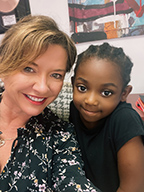
By Malena Mendez, President and CEO, Big Brothers Big Sisters of Broward County
 As a brand-new mentor in the Big Brothers Big Sisters of Broward County program, the impact of mentoring has become more real and infinitely more significant. This new experience has opened my eyes to the lifechanging path of the mentoring relationship.
Although being a Big Sister is new to me, I’m no stranger to the good work of this nonprofit organization, now celebrating 50 years in our community. I’ve been a supporter of Big Brothers Big Sisters for years and took the helm of the Broward agency two years ago as President and CEO.
That said, now that I’m immersed in a Big/Little relationship, it all feels brand new with surprises and joys as well as bumps and challenges. Now I have a personal understanding of what it means to be a mentor. And I love mentoring my Little Sister, adorable six-year-old Malaysia, who is a sassy delight.
It started like all of our matches do. I filled out a detailed questionnaire and had a long discussion with a match support specialist about my family background and my likes and dislikes. As we spoke, the match support specialist began to understand who I was. She was thinking about the girls on the waitlist who had interests similar to mine with the goal of establishing a suitable and sustainable match.
She also was considering the families of the children. It’s as important for the mentor to connect to the parent(s) or guardian as it is to connect with the child. A Big/Little relationship is not about two people, it’s about at least 3 people. The parent, typically single, or guardian partners with the adult mentor to support the child. After taking into consideration these various factors, the match specialist recommended Malaysia as my Little.
When I met Malaysia, I have to say I fell in love with her. I also met her mother, and we immediately established a positive rapport.
Malaysia lives in a bustling environment. She has eight siblings, ranging from four months to 19-years old. To say her mom is busy is an understatement for sure. The sheer numbers create a certain joyful, boisterous homelife. In short order, I realized that what I could give Malaysia was my undivided attention in a focused, relaxed, and fun setting.
Malaysia and I now have been matched about seven months. We’ve had lots of fun and typically end each outing with our signature McDonald’s McFlurry. (Malaysia loves them.) We’ve also had some challenges, where I’ve had to set expectations to help her understand why the answer sometimes is “no.” Overall, however, we’ve had a blast. It’s been a great learning experience for us both.
While I know it’s a treat for Malaysia every time we get together, I think it’s even more fun for me. As a mother of two grown-up boys, I get to experience life through the eyes of a child again. It’s extremely special. And even though Malaysia’s only six, I think she recognizes how meaningful our time is together. She’s very intuitive and thoughtful, always asking to bring something home to her brothers and sisters.
I’m proud to be Malayshia’s Big Sister and look forward to watching her grow up as our relationship deepens over the coming years. This experience has fueled even more urgency to match every child on our waitlist with a mentor. And while it took two months from beginning to end to be matched with Malaysia, it takes double or triple the time for boys to be matched. We simply have fewer men who have stepped up to be mentors.
While we would like to see all men, and women for that matter, volunteer to become Bigs, we particularly need Black men to become Bigs. Of the 797 youth waiting to be matched, 62 percent are Black boys. The majority of their families request that their child be matched with Black men. Truly, the need is great.
The good news is that over the last couple years, we’ve increased our capacity to serve more youth by securing more funding, expanding our footprint, adding personnel and improving our infrastructure. As a result, we’ve launched the Road to 3,000 initiative with the goal of serving 3,000 youth by 2025. By the end of the year, our hope is to have matched 1,100 Littles.
We’re excited about serving additional youth because this program works. Seventy percent of the youth in our program receive free or reduced lunch, indicating low-income circumstances, and 23 percent have a parent who is or has been incarcerated. The odds are stacked against these young people, yet our kids defy their circumstances. Last year, 100 percent of our Littles graduated high school, 80 percent were promoted to the next grade level and 99 percent stayed out of the juvenile justice system. They also manage their emotions better, are more socially competent, and are more connected at school.