Panel urges NAACP to keep up fight for Voting Rights Act
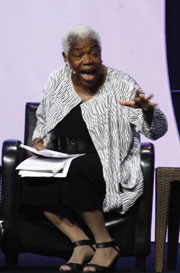
Elaine Jones, a prominent civil rights attorney and activist told a packed hall at the Orange County Convention Center in Orlando, Fla., that the Supreme Court has always been known to put the brakes on social change. (Duane C. Fernandez, Sr./Hardnotts Photography)
By James Harper From the Florida Courier
ORLANDO, FL – Elaine Jones is no stranger to putting out fires when they have been set by those who want to take away the voting rights of Blacks. But she also knows how to start fires, if necessary.
In her role as “firestarter,” Jones took aim at the Supreme Court during a July 17 panel discussion on the Voting Rights Act at the NAACP’s 104th national Convention in Orlando.
Last month, the court decided to kill Section 4 of the act, which determines the coverage formula the federal government uses to determine which states and political subdivisions are subject to continued oversight. In effect, it guts Section 5 of the law that requires any changes in voting laws and procedures in those covered states have to be precleared with the Justice Department or a federal court that make sure they don’t neuter the rights of people of color.
Nine states, mostly in the South, and parts of six others, including Florida, had been subject to the law. The affected Florida counties were Collier, Hardee, Hendry, Hillsborough and Monroe.
“We bled, died and marched and got something – the Voting Rights Act. The Supreme Court has never liked the Voting Rights Act,” she said.
“Section 5 is the automobile. Section 4 is the key. They took away the key – say the formula is too old, intrusion in rights of states. The Supreme Court got out of their lane,” said Jones, noting it is now up to Congress to rewrite the law.
She said they will now have to spend money to fight the change because Section 4 was struck down.
Jones called on the NAACP members to help them come up with evidence to convince Congress the Voting Rights Act is still needed.
“They are betting we can’t get it done,” she remarked.
“We will go where evidence takes us. We may include more jurisdictions (covered by the law),” she said, adding that when the law is rewritten, it will need a “tamper-free lock.”
Jones said the court has looked at the Voting Rights Act at least four times since it was passed almost 50 years ago, which she said is unheard of when it comes to laws passed by Congress.
“Usually, when the Supreme Court makes a decision, it can rest 15, 20 years. Not so when it comes to race. When it comes to race, it is a different ball game,” Jones said.
She also noted that affirmative action has also been unfairly targeted by the Supreme Court.
Also participating on the panel were the Jesse Jackson; Barbara R. Arnwine, president and executive director of the Lawyers’ Committee for Civil Rights Under Law; Wade Henderson, president of the Leadership Conference on Civil and Human Rights; and Derek Johnson, president of the Mississippi State NAACP. Hilary Shelton, NAACP Washington Bureau Director and Senior Vice President for Advocacy, presided.
Jackson said the court’s decision is the beginning of unraveling the entire infrastructure of the Voting Rights Act. The decision can lead to a “radical scheme of gerrymandering,’’ he noted. “We could lose half of the Black Caucus because of gerrymandering. We must move right now. Keeping voting rights oversight is the right fight.”
Henderson, former Washington bureau chief of the NAACP, said the civil rights group is needed now more than ever.
“We will not stand for this travesty. It’s a challenge, but we can strengthen the Voting Rights Act,” he said.
Arnwine said June 25 will be known as the “Day of Infamy.’’
“The decision of the court was not based on justice. The court said because we had huge Black voter turnout, Section 4 not necessary,” she said, echoing Jones’ pleas for NAACP members to take an active role in getting the law passed again by Congress. “If it smells like discrimination, call us. We will rise up for justice.”
Mississippi NAACP President Johnson said the only way to assure victory “is to be strategic and focused.”
He explained, “We are the eyes and the ears on the ground. Anytime there is change (in voting laws), we must report it. Build a record, no matter how insignificant; information is power.”
Henderson declared, “We have to strike now that momentum is there.”