 Publishers Charles Tisdale and M. Paul Redd honored by former peers
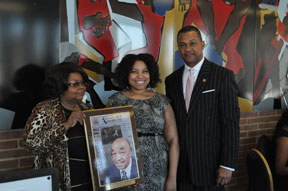
DeAnna Tisdale (center) with Mary Denson, chair of NNPA Foundation and Cloves Campbell, chair of
(NNPA Photo by Roy Lewis)
By Jazelle Hunt NNPA Washington Correspondent
WASHINGTON,D.C. (NNPA) – Two legendary publishers – Charles Tisdale of the Jackson Advocate in Mississippi and M. Paul Redd, Sr. of the Westchester County Press in New York – have been posthumously inducted into National Newspaper Publishers Association Foundation’s Distinguished Black Publishers’ Enshrinement.
They were honored here last week during Black Press Week’s annual observance. The ceremony is reserved for stalwart publishers who have significantly contributed to the legacy of the Black Press.
Benjamin Todd Jealous, former executive director of the NNPA Foundation and immediate past president of the NAACP, gave remarks about each honoree.
“We’re here to pay homage to two great men. What connects them is that, in many ways, they helped to revive the Black Press at a time when many people questioned if we had a future,” he said.
Charles Tisdale, who continually published the Jackson Advocate despite its offices being repeatedly firebombed, was remembered for his courage. Jealous, who served as managing editor under Teasdale, recalled Tisdale’s standing monthly lunch date with a former Ku Klux Klan grand wizard.
“There I was, at [Tisdale’s] bedside, and in walks… this man, the former head of the Ku Klux Klan. This grand wizard sits down at his bedside and starts crying, ‘’This man understood me. This man listened to me,’” Jealous said. “The power of the Black Press we often refer to is voice. But [through Tisdale] I learned you cannot lead until you listen.”
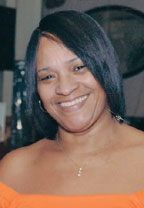
Tisdale’s daughter, DeAnna Tisdale, accepted the commemorative plaque honoring her father, and told the story of her parents’ tenacity in publishing the paper.
“Throughout the trials and tribulations we faced, not a week went by that the paper didn’t go out. When we got firebombed – this last time – I was about 12. And our mom did the paper in the house. She didn’t leave the house almost an entire week,” she said. “It takes a strong person to be a publisher. My dad was an upfront, no-holds-barred, strong person.”
DeAnna, who is studying graduate-level vocal performance at the Boston Conservatory, treated the gathering to an aria titled, “Io Son L’umile Ancella” (“I Am the Humble Servant of the Creative Spirit,” from the opera, Adriana Lecouvreur).
“In this aria…she uses words as a vessel, as a means to get across the way that she feels,” DeAnna explained. “And as publishers and as journalists, you do that every day. Words are power. You use those words to change things…to impact lives, to impact the future, to solidify past. And I think that this [piece] is very appropriate.”
The other honoree, M. Paul Redd was as much an advocate as he was a publisher. He was a Gold Life Member of the NAACP; board member of the Girl Scouts, the Urban League, the United Way, the American Red Cross; founder of the Black Democrats of Westchester; and president of the Westchester/Putnam Affirmative Action Program, which provided job training and placement for approximately 4,000 women and African Americans over a seven-year span.
Most notably, Redd and his wife, Orial Banks Redd, filed and won a housing discrimination case against New York State when they were denied an apartment in Rye, N.Y. This victory spurred a flurry of housing anti-discrimination legislation in New York, one of which became commonly known as the Redd Bill.
Redd was also revered for his column, “M. Paul Tells All,” which Jealous described as “a love letter to our community,” encouraging readers to take up their civic duty.
His successor, Sandra Blackwell, accepted his commemorative plaque.
“He was always looking for young people to take things on, and people gravitated toward him – he had a way of disarming people with his humor,” Blackwell said, referring to Redd. “He had his column for over 40 years, so I have a memorial for him on his page at all times. I can’t take him off the masthead.”
The Black Press gallery is housed at Howard University. The Black Press archives are stored at the Moorland-Spingarn Research Center at Howard. After the ceremony, the publishers, NNPA Foundation board members and executives, and their guests, walked across the campus main yard to view the gallery of enshrined publishers, dating all the way back to Freedom’s Journal, founded in 1827.
Other famous enshrined Black publishers include Frederick Douglass, Howard B. Woods (of the St. Louis Sentinel), and Daisy Bates (of the Arkansas State Press).
A publisher can be nominated for enshrinement after he or she has been deceased five years. If the foundation receives more than one nomination in a year, a committee of publishers chooses the awardees.
“I’ve spent 53 years of my life devoted to the Black Press,” says Dorothy Leavell, publisher both the Chicago Crusader and the Gary Crusader and former chair of the NNPA Foundation. Her first husband is also enshrined at Howard.
She said, “It is a really great thing for us to have all of this here, and our press recognized as an important institution.”