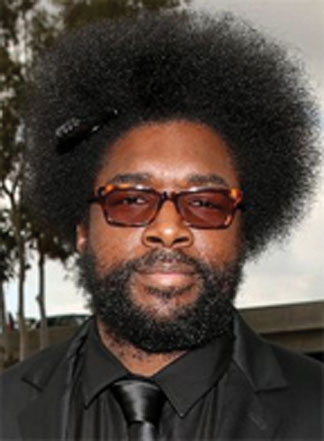
Still a N*gga: QuestLove admits to being racially profiled even after achieving stardom
By Victor “Doc V” Trammell
Since the cosmetic eradication of America’s Jim Crow era, many Black people have been able to use careers in education, business, entertainment, and the field of law to achieve financial abundance and national prominence.
The personal success stories of people like Dr. Melissa Perry, Alice Walker, Michael Jordan, and President Barack Obama are examples of Black progress in a nation that has been dubbed “post-racial.”
These stories can also be used as ammunition by elitists on both sides of the mainstream ideologue who profess that racism is no longer a problem. Conservatives and liberals alike would probably love an America with no one voicing complaints against society about discrimination based on race or ethnicity.
However, many current and recent dilemmas have disproven the boundless theory that racism is no longer a big problem. Racial imbalances in the criminal justice system were exposed with the verdict in the Trayvon Martin case.
The disparities in the nation’s major unemployment problem reflect an inequality that is affecting Black people in poor communities across America.
Therefore, many people in what conservatives call the “grievance industry” have a legitimate argument that the advocacy of civil rights for societies underserved is still necessary. Hip hop culture started off as a voice for the underserved people who need advocates fighting for their equality. The hip hop music genre has also produced some of Black America’s most influential people.
The Roots front man QuestLove is one of hip hop’s most critically acclaimed figures. His rap group has released music that definitely reflects the essence of the culture they represent. The 42-year-old producer and musician recently held an interview with the social justice news source Democracy Now.
QuestLove talked about the problems with police profiling he’s experienced over the last 26 years, both before and after he achieved national stardom. He quoted the following statement about the first time he experienced racial profiling:
“There’s nothing like the first time a gun is held on you. I remembered my father telling me, ‘if you’re ever in this position, you’re to slowly keep your hands up’…..How I knew that was the protocol at that young age, I mean, it’s probably a sad commentary, but it was also a matter of survival.” (Democracy Now)
QuestLove also recently told ThinkProgress.org about a 2010 police profiling incident that demoralized him the night before he won a Grammy Award. He also appeared in Orange County, California that night to support President Obama. QuestLove told Think Progress:
“I pulled over to the side of the road to call my manager when five police cars began to surround me. Police then made me get out of my car and sit in the back of a cop cruiser while they searched [my car]. The stuff I had in the trunk was some psychology books and some scrabble games. In my head I thought, there is no way they are going to believe they’re going to believe that stuff belongs to me.”
It is commendable for QuestLove to be speaking out against societal oppression in a day and age where bad actors are arguing that it does not exist. His 2010 situation is a reflection of the point of view many in hip hop and elsewhere have publicly expressed: No matter what you accomplish as a Black person in America, in the eyes of many you will always be inferior.