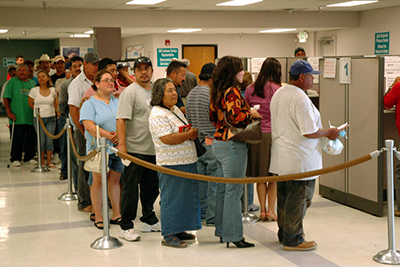
The Initial Impact on Employment was Largest for Women, Black workers, Latino Workers, and Less-Educated Workers.
By Stacy M. Brown, NNPA Newswire Senior National Correspondent@StacyBrownMedia
A new study focusing on job displacements between 1989 and 2019 found that, on average, Black workers are 67 percent more likely to be displaced than their white peers.
Research by the nonprofit Brookings Institution further revealed that workers without a bachelor’s degree are also 67 percent more likely to be displaced than those with a bachelor’s degree.
Additionally, workers whose parents are in the bottom half of the income distribution are 27 percent more likely to be displaced than those with parents in the top half.
Titled Job displacement in the United States by race, education, and parental income, the study noted that using an event study fixed effects model, researchers measured the impact of a given displacement on annual earnings by worker group.
They discovered similarly large and persistent adverse effects on earnings across all demographic and socioeconomic groups.
The study authors estimated a 57 percent decline in earnings following a dis-placement.
They also estimated a 25 percent decline in the 10th year after a displacement.
During the first months of the COVID-19 recession, an estimated 22 million Americans lost their jobs – roughly 13 percent of the U.S. workforce.
The initial impact on employment was largest for women, Black workers, Latino workers, and less-educated workers.
“This negative employment shock occurred against a backdrop of long-term trends of declining intergenerational economic mobility and high-income inequality across race and education levels,” the researchers explained.
The study examined how job displacements affect workers by race, education level, and parental income in the United States.
“An extensive literature in economics shows that workers experience large and persistent earnings losses following a job displacement,” Brookings researchers determined.
“Given the millions of workers displaced during the COVID-19 recession and the high-income inequality in the United States, it is important to understand the role that job displacement may play in driving inequalities across demographic and socioeconomic groups.”
The authors continued:
“In this [study], we use the Panel Study of Income Dynamics (PSID) to measure the frequency and earnings impact of job displacements by race, education, and parental income level.”
Meanwhile, the authors found that workers whose parents are in the bottom quintile of the income distribution are 27 percent more likely to be displaced than those with parents in the top income quintile.
The study concluded that Black workers, less-educated workers, and those with low-income parents are more likely to be displaced yearly.
But once they are displaced, do these workers experience worse outcomes than their white, more educated, and high-income-parent peers who also share a displacement?
“In the year following a displacement, workers without a bachelor’s degree experience a roughly 600-hour decrease in annual hours worked, while those with a bachelor’s degree see a 1,000-hour decline,” the researchers wrote.
“When we look at Black and white workers separately, we find nearly identical effects on earnings across the five years leading up to a displacement and the ten that follow. However, while the effects are similar for both race groups, large differences in earnings levels still exist across all relative years.
“In the year after a displacement, non-displaced white workers earn roughly $11,500 more than their Black peers, on average.”
Researchers said the report establishes three crucial facts about job displacements in the United States over the last 30 years.
First, as other studies have shown, the adverse effects of a job displacement on earnings, hourly wages, and annual hours worked are significant and persistent.
Also, certain workers experience much higher displacement rates than others in any given year.
Namely, Black workers, those without a bachelor’s degree, and those with low-income parents are much more likely to experience a displacement any given year than their white, degree-holding, and high-income-parent peers.
Finally, the negative effect of job displacement on earnings is relatively consistent across socioeconomic groups.
“While displaced workers with bachelor’s degrees seem to experience less severe earnings losses in the year immediately following a displacement, they also experience larger lingering effects than their peers without degrees,” the researchers asserted.
“However, large standard errors make it difficult to make strong claims regarding differences by socioeconomic status. It is important to remember that, despite the similar impact of job displacement across demographic and socioeconomic groups, there remain large gaps in average annual earnings across these groups – both before and after displacement events.”
They noted further that a critical implication of their findings is that job displacements may play a role in promoting racial, educational, and intergenerational inequality.
“Even though we do not find differences in the earnings effects of any given displacement across groups, we do find that certain groups experience displacements much more frequently,” the researchers insisted.
“Black workers, those without bachelor’s degrees, and those with low-income parents all have lower average earnings than their peers before experiencing job displacements, so the higher-frequency displacements for these groups likely exacerbate existing income differences.
“Focusing exclusively on earnings outcomes, our [study] does not fully capture the potential impact of being displaced. The job displacement literature has found that displacements affect many outcomes besides earnings, such as health and homeownership.”