7-2 Decision Upholds CFPB’s Funding
By Charlene Crowell
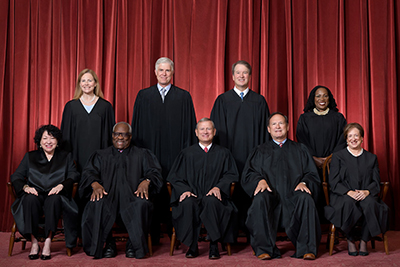
A recent 7-2 ruling by the U.S. Supreme Court gave consumers a long-sought victory that ended more than a decade of challenges over the constitutionality of the agency created to be the nation’s financial cop on the beat.
The May 16 decision in the case formally known as Consumer Financial Protection Bureau v. Community Financial Services Association of America LTD, ET AL refuted arguments by the billion-dollar payday lending industry that CFPB was unconstitutional because its funding is derived directly from the Federal Reserve instead of Congress’ annual appropriations.
The majority opinion, written by Justice Clarence Thomas, concluded, “The statute that authorizes the Bureau to draw money from the combined earnings of the Federal Reserve System to carry out its duties satisfies the Appropriations Clause.”
Two additional concurring opinions underscored this conclusion. Justice Ketanji Brown Jackson, the first Black woman to serve on the Supreme Court and its newest member, addressed why legislators created the CFPB.
“As the Court explains, in response to the devastation wrought by the 2008 financial crisis, Congress passed and the President signed the Dodd-Frank Wall Street Reform and Consumer Protection Act… Drawing on its extensive experience in financial regulation, Congress designed the funding scheme to protect the Bureau from the risk that powerful regulated entities might capture the annual appropriations process,” wrote Justice Jackson.
During the Financial Crisis, millions of Black and Latino borrowers suffered home foreclosures because they were targeted with high-cost, unsustainable mortgage loans, even though many were eligible for other lower-cost loans. But those were not the only predatory financial product foisted upon people of color.
Payday loans that lure financially-strapped consumers with promises of easy cash can still be found in profusion in most urban areas across the country. The payday industry’s billion-dollar profits typically are generated on loans of $350 or less. With high fees that create deepening cycles of re-borrowing, these loans disproportionately affect Black and Latino borrowers who earn $40,000 or less per year, and do not have a college degree. Research by the CFPB found that payday lenders collect 75 percent of their fees from borrowers who take out more than 10 loans per year.
In the absence of federal regulation, 20 states and the District of Columbia have enacted laws to cap payday lending interest rates at around 36 percent annual percentage rate (APR), or required other measures to eliminate long-term debt traps for consumers. Further, since 2005, no state has authorized the expansion of traditional storefront payday lending.
But for the remaining states without reasonable rate caps, triple-digit interest on payday loans continues. Many of these states also have large numbers of minority residents. For example, Texas allows payday APRs as high as 662 percent, similar to Missouri (652 percent), Mississippi (572 percent), Wisconsin (537 percent), and Nevada (548 percent).
Against this backdrop, it remains important for CFPB’s work in support of financial fairness to continue. Consumer advocates’ reactions to this key decision were understandably jubilant.
Massachusetts U.S. Senator Elizabeth Warren, broadly considered the chief strategist for CFPB’s creation during the Obama Administration, said the court decision is a noteworthy development:
“For the last decade, the consumer agency has fought the big banks and predatory lenders that try to cheat hardworking people. As of this week, the CFPB has returned more than $20 billion in ill-gotten funds to American families,” said Warren. “This isn’t the last attack on the CFPB we’ll see from Wall Street, the banks, and their Republican allies.…The CFPB will keep on doing its work to slash junk fees, fight giant banks when they cheat people, and level the playing field for everyone in this country.”
Rev. Dr. Cassandra Gould, Senior Strategist at Faith in Action and Founding member of Faith for Just Lending, said the ruling was as much a moral victory as it was a victory for public policy.
“This Supreme Court decision, which aligns with the moral compass of Proverbs 22:22, has sided with the least of these by protecting the CFPB. This decision is a testament to our shared commitment to not rob the poor because they are poor and to not crush those in need in court,” said the Rev. Dr. Gould.
And for the Center for Responsible Lending (CRL), Nadine Chabrier, Senior Policy and Litigation Counsel at CRL, said this consumer victory should be used as a springboard for even more consumer protection efforts.
“Even with this decision, we must keep fighting to defend our consumer watchdog agency in the courts and in Congress as some industry actors sue and lobby to preserve illegal financial discrimination, billions in unlawful junk fees, and other exploitative behavior,” said Chabrier. “The nonstop crusade to undermine the CFPB goes against the wishes of the American people, who overwhelmingly support the CFPB’s work. The anti-CFPB campaign is an attempt to throw sand in the gears of financial justice and it must be rejected.”