
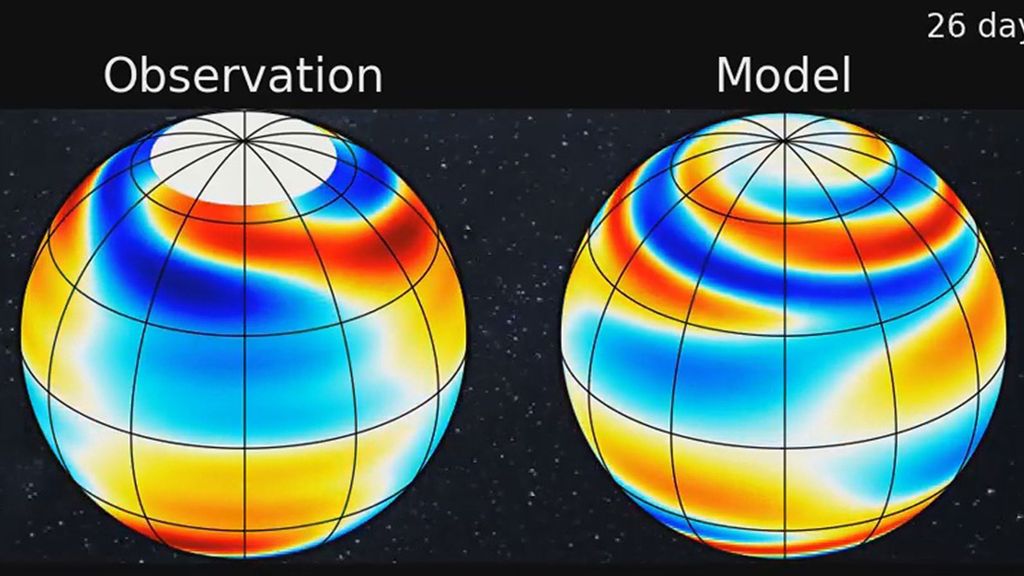
Researchers at the Max Planck Institute for Solar System Research and the University of Goettingen in Germany discovered the “deep low musical notes” of the sun’s oscillations using data from U.S. space agency NASA.
In a statement released by the Max Planck Institute, researchers said the oscillations seem linked to the sun’s own 27-day rotation period and “manifest themselves at the solar surface as swirling motions with speeds on the order of 5 kilometers [3 miles] per hour.”
Researchers said they made the discovery using 10 years worth of observations from NASA’s Solar Dynamics Observatory.
Computer models revealed that these oscillations are “resonant modes,” which means they exist because different parts of the sun rotate at different speeds in a phenomenon called “differential rotation.”
The sun’s high musical notes were discovered in the 1960s, coming from oscillations with shorter periods, near five minutes.
“The sun rings like a bell,” the scientists said.
Millions of modes of acoustic oscillations are excited by convective turbulence near the surface and are trapped in the sun’s interior.
“These 5-minute oscillations have been observed continuously by ground-based telescopes and space observatories since the mid 1990s and have been used very successfully by helioseismologists to learn about the internal structure and dynamics of our star — just like seismologists learn about the interior of the Earth by studying earthquakes,” the statement said.
“One of the triumphs of helioseismology is to have mapped the sun’s rotation as a function of depth and latitude (the solar differential rotation),” the statement said.

“The long-period oscillations manifest themselves as very slow swirling motions at the surface of the sun with speeds of about 5 kilometers per hour — about how fast a person walks”, said Max Planck scientist Zhi-Chao Liang.
In order to work out why these oscillations occur, the team compared the observational data to computer models.
“The models allow us to look inside the sun’s interior and determine the full three-dimensional structure of the oscillations,” graduate student Yuto Bekki said.
“All of these new oscillations we observe on the sun are strongly affected by the sun’s differential rotation,” Max Planck scientist Damien Fournier said.
“The oscillations are also sensitive to properties of the sun’s interior: in particular to the strength of the turbulent motions and the related viscosity of the solar medium, as well as to the strength of the convective driving,” Max Planck scientist Robert Cameron said.
“The discovery of a new type of solar oscillations is very exciting because it allows us to infer properties, such as the strength of the convective driving, which ultimately control the solar dynamo,” said Laurent Gizon, lead author of the new study.
Edited by Katie Taranto and Kristen Butler
The post VIDEO: Here Comes The Sung: Swirls On Sun’s Surface Make It Sing, Say Experts appeared first on Zenger News.
