The cancellation of a Broward literary event raises urgent questions about open dialogue, community trust and constitutional freedom
By Corey Shearer Sr., “A Son of Broward” and President, Broward County Democratic Black Caucus
What constitutes being persona non grata in today’s socially charged, social-media-dominated world? Is it suspicion of espionage, a violation of local law or a threat to national security—the traditional meanings of the term? Or has it come to mean simply that someone has fallen out of favor and may therefore be excluded from a workplace, institution or public event?
If the label now serves only as a signal of disapproval, it carries little weight and even less credibility. It certainly should not be enough to move a local government agency, much less an entire county school system, to silence a respected author and cancel a long-standing community program.
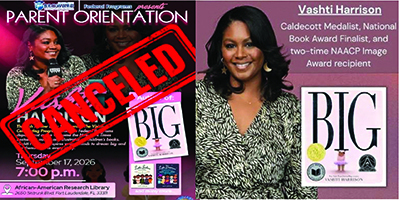
Vashti Harrison is an award-winning author and illustrator. Let me underscore, Vashti Harrison is a winner of the prestigious Caldecott Medal, the first African American female to win in its almost century of existence. The Caldecott Medal is an annual award given by the Association for Library Service to Children (a division of the American Library Association) to the artist of the most distinguished American picture book for children. Her books—including Big, Little Leaders, Little Dreamers and Little Legends—help families and communities begin conversations about history, identity, self-worth and possibility.
On September 17, a Broward County parent who lives outside the immediate community sent Superintendent Howard Hepburn and the School Board a letter raising concerns about Harrison. And we are not oblivious to the fact that there are a group of other elected and prior elected officials that continue to advocate for censorship and marginalization of those that speak out against some of the military actions of Israel and speak up for ceasefire or protection for children in Gaza.
In this case, the apparent reason for unforgivable concern was Harrison’s signature on the 2024 KidLit4Ceasefire open letter, a publishing-industry campaign that called attention to the deaths of children and urged a ceasefire in Gaza. The letter was public. The response to it, however, was neither open nor evenhanded. That contrast should raise the real red flag: an open expression of conscience appears to have prompted an opaque institutional reaction.
The African American Research Library and Cultural Center is more than a building. It is a trusted convener of artists, writers, educators and cultural artifacts. It creates moments of wonder, starts difficult conversations and opens the imaginations of people from childhood through adulthood. Programs such as the Ashley Bryan Art Series belong to that mission.
Samuel Morrison’s vision for a grand library serving Black Broward was built donation by donation—with support from the National Endowment for the Humanities, a $50,000 contribution from The Links, Incorporated, and gifts from clubs, churches, organizations and individuals who cared deeply about what Black Broward lacked and deserved.
Ashley Bryan, like Vashti Harrison, was an award-winning and widely respected author and illustrator of children’s books. Both have left us with unparalleled work rooted in the African American experience. How, then, does an author whose literary focus centers Black children, Black history and Black possibility become a perceived threat to a program created for our community? Is this about the work itself, or is it retribution aimed at anyone who publicly questions Israel’s conduct in Gaza or calls for a ceasefire?
Harrison has not written a book about Gaza, nor is she known for illustrating a book about Gaza. Her connection to the issue arises from her public support for a ceasefire. Whatever one’s political position, calling for the protection of children should not disqualify an author from discussing literature, art and imagination with young people.
Arguments over competing casualty estimates miss the moral point. No just society should look away when large numbers of children are killed. After world wars and regional conflicts, humanity has repeatedly pledged to do better. At the very least, it is human to call for the violence to stop and to plead for children’s lives to be saved.
Because meaningful public discussion has been missing, I intend to help begin it—with groups and residents in public libraries throughout Broward County. We should lower the temperature without lowering our voices. We should bring thoughtful discussion about human dignity, the value of every life and agape love into the very spaces created for education and civic exchange.
Vashti Harrison was removed from an event, and the entire historic, decades-long program was then canceled. Broward County Public Schools issued an apology to those who objected, yet showed little public concern for First Amendment values or for residents who support open dialogue and oppose retaliation against people who take a moral stand.
If Broward Schools did not meaningfully consult the community before canceling our community’s event, what lesson should we draw? Has the district become an instrument for those seeking retaliation even when the target is neither dangerous nor disruptive? How does that square with the district’s anti-bullying message to speak up when we see wrongdoing? What example does this set for our children—or for the adults responsible for guiding them?
The message many of us heard was blunt: stand too close to this issue and you, too, may be burned. Our answer must be equally clear: we will not surrender the firehose of discussion, close the firehouse of education or deprive our community of the literary voices best equipped to illuminate difficult truths.
Our block is already hot. We will meet heat with disciplined action—independent, unbought and unbossed. This is where we draw the line and build a firebreak before censorship and retaliatory exclusion spread any further through Broward County’s connected African American communities, especially when neither the alleged offense nor the demand for punishment originated within those communities.
Theodore Parker, the 19th-century abolitionist minister, wrote that although he could not fully understand the moral universe, he was sure its long arc bent toward justice. The Rev. Dr. Martin Luther King Jr. later gave that idea its best-known expression: “The arc of the moral universe is long, but it bends toward justice.”
What we are witnessing is unjust: the rapid use of institutional power to punish speakers, threaten programs or cancel events because someone signed a ceasefire letter or advocated for peace. Suppressing dissent over Palestine—and penalizing those who criticize Israeli actions during the war in Gaza—requires democratic norms to be weakened again and again.
One of the most lauded African American authors and illustrators of the past century was told you are not welcome to be around our kids, parents and library in our historic African American community. That is not a victory for anyone. It diminishes constitutional freedom and erodes the foundation of the American democratic experiment.
When we assess what is happening here and across South Florida, the message remains painfully clear: might does not make right except when you are perceived to be the most vocal and powerful in South Florida. And even the most universally respected African Americans need to check in at the door before entering.