Source: Pittsburgh Courier)
By Meleisa Ono-George, University of Oxford
In 2026, a new memorial to the 12.5 million enslaved people transported to the Americas and Europe – and their descendants – will be unveiled on West India Quay in London’s Docklands.
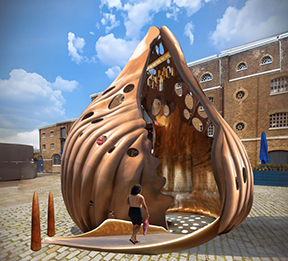
The winning commission, an installation piece by US artist Khaleb Brooks called The Wake, will take the shape of a seven-metre bronze cowrie shell – the currency that was used in the trade of enslaved peoples, and an object symbolic of the entangled history of slavery and capitalism.
The location of this installation, outside the London Dockland Museum, means it will in effect replace the statue of Robert Milligan, the Scottish merchant and slave trader, which was removed, shrouded and covered in words of protest in June 2020.
The project for a public monument to transatlantic slavery, and London’s connection to it, came out of the Commission for Diversity in the Public Realm – the committee set up by the city’s mayor, Sadiq Khan, amid the 2020 Black Lives Matter (BLM) protest, and announced on the same day the Milligan statue was taken down.
Over three years, the project undertook extensive consultation and engagement with Londoners, including community groups and heritage organizations, as well as experts in the histories of slavery and race in Britain, including myself. The final selection of The Wake was by a public online vote.
The announcement of this installation feels particularly important, just as we are seeing so many promises that came out of the BLM protest discarded: commitments to address racial disparities and inequalities slowly rolled back; statements of support removed; acts of solidarity forgotten.
This monument could have been another one of these disregarded commitments, “diversity for diversity’s sake” as Sudanese-British journalist Nasrine Malik writes. However, in its design, it seems to be much more than an effort to diversify public monuments and statues on London’s streets, or to replace the statues of slave traders taken down.
Nor is it just an object to be observed. Rather, as Brooks explains, The Wake will be a “remembrance vessel”, a “grieving space” where the public can come together. There is subversive potential in public remembrance and grief. The Wake appears to capture this.
In every way, this sculpture seems to recognize the long and ongoing reach of transatlantic slavery. In the proposed design of the monument, there is more than just a recognition of traumatic events in the past, or an understanding of legacies in the present. The Wake points to an understanding of Black freedom as something that is still unrealized – the “long emancipation”, as Rinaldo Walcott, a professor of Africana and American Studies, calls it.
The title of the installation seems to invoke Black Studies academic Christina Sharpe’s meditation on what it is to live in the “wake” of transatlantic slavery – to live in a society still addressing the legacies of slavery and anti-blackness, where “the past that is not past reappears, always, to rupture the present”.
The beauty of The Wake is in the detail. On the walls, Brooks attempts to list the names of the victims of slavery as far as possible. But these walls also reveal blank scrolls representing the countless millions that cannot be named, revealing Brooks’s resistance to what Canadian poet NourbeSe Philip calls the “broad-brush brutalising” of slave registers that reduced the enslaved to “Negro man, Negro woman, ditto, ditto, ditto”.
The structure also engages sound in the form of bronze windchimes which will generate a deep echo, creating a space that at times feels still and calm, at other times (depending on the winds) unsettled. This unpredictability may change the experience within the shell, and is a powerful reflection of both history and society, and the range of emotions this history and its aftermath draws from each of us.
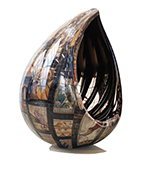
Smaller, human-sized cowrie shells will also be placed around the city, decorated by local community groups and organizations. These “satellite sculptures” are equally provocative in their invitation for public engagement, encouraging the collective ownership of this history.
The history of slavery is not just the history of people of African ancestry (although it is Black life that is impeded by anti-Blackness, one of the legacies of slavery). It is very much Britain’s history, even if not all are willing to acknowledge this. We should expect engagement with The Wake and the satellite sculptures in different ways – from grief, anger and denial to fear and other expressions of backlash.
But this too is part of the ongoing history that Brooks’s installation seems able to capture. The everyday violence of racism and the cultural and ideological legacies of slavery are also part of that history. This is not diversity work but “wake work”, and it is not easy. As Sharpe writes: “It is … hard emotional, physical and intellectual work that demands vigilant attendance to the needs of the dying, to ease their way, and also to the needs of the living.”
The history of the transatlantic slave trade is dark and painful; for some, the legacies of it are equally difficult to face. But it is a history that is all around us. As Canadian poet and novelist Dionne Brand writes: “One enters a room and history follows; one enters a room and history precedes.”
So we all must face it. The Wake will be a good opportunity to come together, to remember and grieve, to literally sit “in the room with history”. But this is a starting point, not an ending.
This article is republished from The Conversation under a Creative Commons license. Read the original article.