 Young people can impact the world by ‘standing on the shoulders’ of mentors
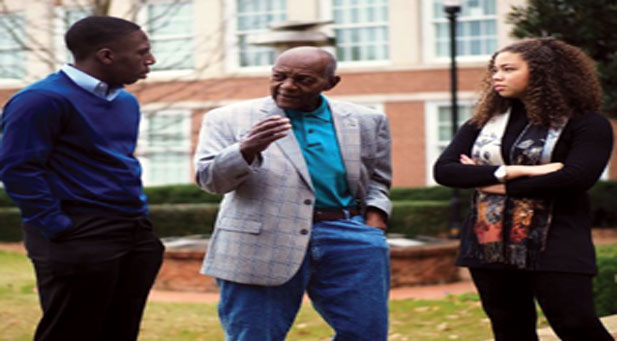
Morehouse College student Jajuan Chain and Georgia State University student Samaria Muhammad listen as civil rights veteran Lonnie King explain principles of leadership and organization. Photo credit: Sheila Pree Bright
By Edna Kane-Williams
When Jajuan Chain, a history major at Morehouse College in Atlanta, needed to interview someone for a class assignment, he reached out to 1960s civil rights icon Lonnie C. King Jr., a founding member of the Student Non-Violent Coordinating Committee (SNCC) and founding chairman of The Committee on Appeal for Human Rights.
After their first encounter, neither King, 79, nor Chain, 22, ever expected that within weeks they would become mentor and protégé working on an organizational project involving Historically Black Colleges and Universities (HBCUs) and other universities in Atlanta that Chain believes will impact the rest of his life.
Chain says that King is taking the time to share his experience to train him as a young leader. And their collaboration is working. “We want more than a movement,” Chain says. “We want something that’s going to last for generations, something that’s going to have substance that will not only have a national impact, but an international impact.”
Unlike King and Chain, clarity and understanding between young and older generations has not always been the case during recent uprisings against police killings of unarmed African Americans over the past several years. Photographer Sheila Pree Bright, who documented recent demonstrations in Ferguson, Mo., and Baltimore, has been an eyewitness to the friction.
“Based on my experience from being on the ground, a lot of young people are angry at the elders from the civil rights movement,” she says. “They said that it seems that after Dr. King got assassinated they dropped the ball and they feel like they are fighting the same fight that their parents and grandparents were fighting.”
Bright recently organized a forum featuring young activists on a panel and elders in the audience. She discovered that the youth needed to be heard. But when young people also listen, they are sometimes “lost for words when asked how they are going to do certain things…We don’t know how powerful we are together.”
That’s where the wisdom of the elders come in, Chain says. “If you want to go far, you really have to learn from someone who’s done it before you. They may not be caught up in the same social evolution as you with technology and other things. But they understand the principles, and that’s something that I’ve been adopting in my life.”
So far, King says he has taught Chain and his co-leaders key battle strategies and how to organize people to make lasting change. “Marches and rallies don’t solve problems, but basically raise people’s awareness of what’s going on,” King says. “You’ve got to have that backdrop of organization if you’re talking about institutional change.”
Following King’s advice, Chain is organizing a multiracial student group consisting of Blacks, Latinos and forward-thinking white students who may have different perspectives on the same problem. Seeing his vision coming together, Chain says he is amazed at what he is achieving by listening to King.
“He’s showing us how to create a mass organization and how to organize people. And he’s shaping me on how to be a more profound leader and how to develop well thought-out ideas,” Chain says. “He’s actually molding me to become a leader. And I’m truly grateful for that.”
Edna Kane-Williams is senior vice president for multicultural leadership at AAR