

Written By Shannon Dawson , Staff Writer
Most people know about labor unions, but few know what they do. As we celebrate Labor Day in 2022, let’s take a second to reflect on Black workers’ rights and the important labor unions that have paved the way.
Labor unions help employees push for better working conditions within a workplace, which might include improving wages, hours, and safety policies. Labor unions then help workers bargain for a legally binding contract that will hold their employers accountable for implementing said changes.
Sounds simple right? Well, historically, that hasn’t always been the case, especially for Black Americans.
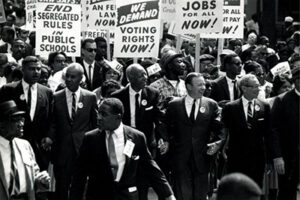
Civil rights icon Dr. Martin Luther King Jr. gave his legendary speech “I’ve Been to the Mountaintop” right at the height of the Memphis Sanitation Workers’ Strike in 1968. On April 3 that year, 1,300 sanitation workers organized a massive strike against the city, demanding better safety conditions, livable wages, and union recognition.
“We’ve got to give ourselves to this struggle until the end,” King said to the fearless sanitation employees as they stood in the crowd. “Nothing would be more tragic than to stop at this point in Memphis. We’ve got to see it through. And when we have our march, you need to be there. Be concerned about your brother. You may not be on strike. But either we go up together, or we go down together.”
The workers were protesting the shocking deaths of Echol Cole and Robert Walker, who were crushed by a malfunctioning garbage sanitation truck. The movement was led in part by a former Black sanitation worker named Thomas Oliver Jones. As the president of the local 1733 chapter of the American Federation of State, County, and Municipal Employees (AFSCME), Jones helped the group fight for their rights.
After a series of strikes and contentious run-ins with state police officials, the City Council finally recognized the union and guaranteed better wages on April 16. The event undoubtedly served as a turning point for civil rights in Black America.
Thankfully today, things have changed. According to a study conducted by CEPR, 14.1 percent of Black workers are unionized in 2015. On average, Black union workers earn 16.4 percent higher wages than Black non-union workers. But the work to increase this number continues. The study notes that “unionization rates for Black workers have declined across all sectors, but the decline has been especially steep for manufacturing (from 42.3 percent in 1983 to 13.3 percent in 2015).”
This labor day, it’s important for us to reflect on how far we’ve come. For Black Americans in particular, we have a storied history of fighting tooth and nail for our freedom not only to live but work in the United States. Many African American-led labor unions have helped the community throughout history gain access to the freedoms we deserve. We would be remiss if we did not give them their flowers during this holiday celebration. Let’s take a look back at history.
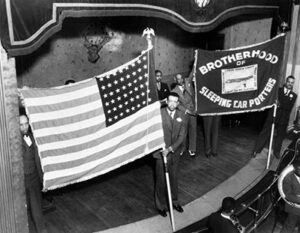
The Brotherhood of Sleeping Car Porters (BSCP) was the first African American labor union to be recognized by the American Federation of Labor.
The union was organized by African American employees of the Pullman Company and spearheaded by both A. Philip Randolph and Milton P. Webster. It was established in 1925.
“The BSCP fought a three-front battle against the Pullman Company, the American Federation of Labor, and the anti-union, pro-Pullman sentiments of the majority of the Black community during its 12-year tenure,” the Black Past website notes.
They even helped to organize The March on Washington alongside Dr. Martin Luther King, Jr.
Largely successful on each front, the BCSP is a significant institution in both the labor and civil rights history of the twentieth century in the United States.
The Colored National Labor Union was established in 1869 by African American workers to organize their labor collectively on a national level. Like other labor unions in the United States, the organization created the union to help fight for better working conditions for Black workers. At that time many people of color were excluded from existing unions like the predominantly white National Labor Union (NLU).
Among the goals of the CNLU, which represented African American laborers in 21 states, was the issuance of farmland to poor African Americans in the South, government aid for education, and new non-discriminatory legislation that would help struggling Black workers.
Founded by Dorothy Lee Bolden in 1968, the National Domestic Worker’s Union of America allowed domestic workers to fight for better wages. An organizer in the civil rights movement and advocate for women’s rights, Bolden was inspired by her own plight as a domestic worker.
A cultural revolutionary, Bolden was forced to enter the workforce at the age of nine to make ends meet for her family. Bolden’s eyesight became hindered after suffering from a fall, compromising her ability to take on certain jobs.
She first organized domestic workers in Atlanta, Ga. learning from her conversations with other domestic workers while taking public transportation. Through the union, thousands of women have secured better pay and working conditions throughout the United States.
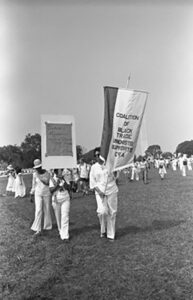
The Coalition of Black Trade Unionists (CBTU) is a nonprofit organization of African American trade union members that was established in 1972. This group is also an official member of the AFL-CIO, one of the United States’ largest federation unions. More than 50 different international and national trade unions are represented in CBTU and there are 50 chapters in the United States.
Some historians believe that the American League of Color Laborers was the first African American labor union to form. Led by Fredrick Douglass, the AALU was created in 1850 to help skilled free craftsmen hone their abilities in the agricultural and industrial industry. It also aimed to encourage African Americans to establish their own businesses. The AALU often acted as a liaison between Black workers who encountered difficulty negotiating fair labor contracts with white workers and labor unions.
