
By Don Valentine
All of the Black escaped slaves did not use the Underground Railroad to migrate North. From 1700-1850, most of the slaves in Alabama and Georgia fled to the safe haven of Florida. At this time Spain owned Florida and they abolished slavery in 1693. Florida became a land of respite for our Black forefathers. Several hundred families of the Black Seminoles still remain in their nation. After the abolishment of slavery in 1864, these families continued to live in their camps and homes deep in the Everglades.
They lived in harmony with the Seminoles. Their proximity to and resulting collaboration with the Seminoles led to the description of the group to be called Black Indians, or Black Seminoles. This connection evolved into the Black Seminoles becoming accomplished warriors.
They were celebrated for their bravery and tenacity during the three Seminole Wars in the 1800s. The Native American Seminoles living in Florida were not one tribe but many. They spoke a variety of Muskogean languages and had formed an alliance with the ex-slaves to prevent European settlers from expanding into their homelands.
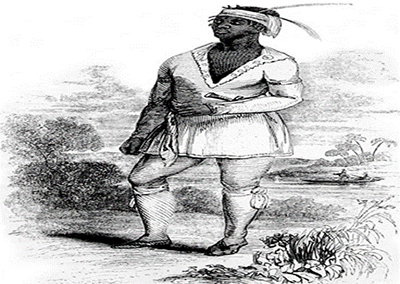
Arguably, the most fear-some of the Black Seminoles was John Horse. John Horse gained his initial fame for joining with a Mikasuki brave named “Wildcat” (Coa-coochee). John Horse had been fighting alongside Osceola and acting as his interpreter by this time. When they were seized while under a flag of truce during negotiations with Jesup’s emissary, Florida militia general Joseph Hernandez, John Horse found himself imprisoned along with Osceola and other members of his band at Fort Marion, the old Spanish fort that formerly defended St. Augustine, the colonial capital of Spanish Florida. The pair led a daring escape from the Fort. The Fort, until then, had been believed by American forces to be unbreachable.
Wildcat and John Horse formed an alliance and went on to lead the remnants of the shattered Seminole bands. This included members of the Mikasuki, Tallahassee, Apalachee and Yamassee bands. Horse led them to safety in the south-central part of Florida, ahead of General Jesup’s forces. In the Battle of Lake Okeechobee on Christmas Day in 1837, Halpatta Tustanagi (Chief Alligator), an ally of the captured Osceola, and the Seminole Black medicine man Abiaka (Sam Jones) led the escaping Seminole with Wildcat and John Horse. They managed to hold off the assault of General Zachary Taylor, who was then in hot pursuit.
They successfully assisted the escape of most of the fleeing Seminole. The Seminoles had joined with them by crossing Lake Okeechobee to take refuge in the Everglades.[ They fought General Jesup himself on the Loxahatchee River the following January 1838. Unfortunately, the losses they had suffered since their early victories in 1835 and 36 had taken their toll. Although General Jesup was wounded in the fight, ]the Seminole were forced to flee again.
Offered a promise of peace and a new life west of the Mississippi with his family, John Horse finally agreed to surrender, although Wildcat refused to come in at that time and fought on until around 1840 when John Horse was brought back to Florida from his exile in Indian Territory. John Horse brought the offer of peace to Wildcat, contingent on his surrender and agreement to exile in Indian Territory. Wildcat, by then was the leading war chief of the remaining Seminole, accepted removal to the Territory (in present-day Oklahoma) which had been set aside for the eastern Indians in the early 1830s by Congress. Other bands still held out, as the war continued until August 14, 1842, when Colonel William J. Worth, finally declared “victory” and left the remaining fighters to their own devices deep in the Florida Everglades.
