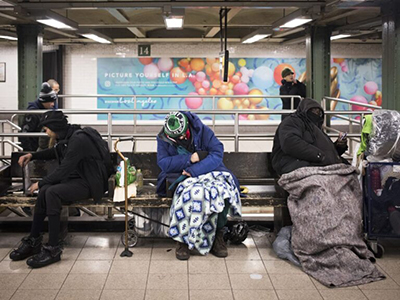
The nonprofit Coalition for Homeless reported that about 57 percent of heads of households in shelters are Black, 32 percent are Hispanic/Latinx, 7 percent are white, less than 1 percent are Asian-American or Native American, and 4 percent are of unknown race/ethnicity.
By Stacy M. Brown,NNPA Newswire Senior National Correspondent@StacyBrownMedia
Homelessness in New York City has reached its highest levels since the Great Depression of the 1930s, with Black and Hispanic residents disproportionately affected.
The nonprofit Coalition for Homeless reported that about 57 percent of heads of households in shelters are Black, 32 percent are Hispanic/Latinx, 7 percent are white, less than 1 percent are Asian-American or Native American, and 4 percent are of unknown race/ethnicity.
The numbers are startling, and when adding a mental health component and recent high-profile attacks on the homeless community in the Big Apple and the nation’s capital, many advocates said the statistics are more alarming.
Earlier this month, police arrested Gerald Brevard III, 30, linking him to shootings that left two homeless people dead and three wounded in the District and New York City.
The arrest came just a day after police departments in both cities published fliers with a photo of the suspect and telling vulnerable residents to seek shelter.
According to the Coalition for Homeless, in January 2022, approximately 48,413 city residents were homeless, including 15,057 children who sleep each night in the central municipal shelter system. In addition, a near-record of 18,749 single adults slept in shelters each night in January 2022.
Research provided by the Coalition revealed that, compared to homeless families, homeless single adults have higher rates of severe mental illness, addiction disorders, and other severe health problems.
Additionally, the number of homeless New Yorkers sleeping each night in municipal shelters is now 15 percent higher than ten years ago.
The number of homeless single adults is 92 percent higher than ten years ago.
Further, in November 2019, officials estimated that 77 percent of adult families, 68 percent of single adults, and 53 percent of families with children sleeping in shelters had at least one disability.
“New York City faces unique challenges with its homeless population in terms of mental health,” said Jesston Williams, the executive director of Tangelic, a start-up organization geared to helping people move on from traumatic experiences.
“Homeless single adults experience higher rates of addiction disorders, mental illness, and other severe health complications than homeless families. Furthermore, the pandemic seems to have worsened these underlying structural issues and what organizations, the government, and citizens can do to alleviate the problem,” Williams wrote in an email.
Since Brevard’s shooting spree and subsequent arrest, the New York officials announced plans to remove the homeless from subway stations where many take shelter.
Williams said the plan includes strict enforcement of mental health services, transit system rules, and housing options.
Studies have shown the cause of homeless for most include eviction, inadequate affordable housing, job loss, domestic violence, and hazardous housing conditions.
“Installing dozens of mental health professionals who can order involuntary hospitalization of homeless people deemed a danger to themselves or others [can help],” Williams noted.
Michael Rose, a founding partner at the New York City law firm Hatch & Rose, said the more things change, the worse they are for the homeless.
“The mask that the city wears may change with gentrification, but the real face of New York never does,” Rose insisted.
“Seeing so many people living on the streets is a constant reminder for most residents that we’re all just a couple of paychecks from being there ourselves, and in the city that never sleeps where the pace of life is always frantic at best, that’s a red rag to a bull. It can and does eat away at people and can be the spark that lights a tragic, brutal touch paper.”
Rose wondered how all could address the issue.
“Maybe if we actually cared enough as a city to do something more about eliminating homelessness, we could start our journey down the path to being the best version of ourselves that we can be,” Rose stated.
“Will that happen? Speaking from experience as a New York lifer, I think its chances are slim to zero.”
Still, advocates remain adamant that being homeless brings about specific other mental stress, particularly if homelessness persists.
Multiple reports have outlined that mental stress and illness have proven even more evident in homeless individuals who already struggle with mental health issues.
“Many of them have experienced more isolation and material harm that would physically and mentally impact anyone,” Catherine Trapani, executive director of Homeless Services United, told reporters.