Letter to young witness in the Trayvon Martin Murder Trial
Rachel Jeantel, the young woman who was on the phone with Trayvon Martin the night he was killed, was grilled by George Zimmerman’s defense attorney and the media on Wednesday. And Khadijah Costley White wants to apologize to her on behalf of the world.
Dear Rachel,
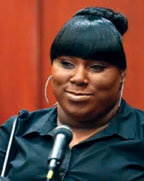
I write this as I watch you testifying, tightening your lips, grinding your teeth in an attempt to be stoic, to not break down while you recount the grisly, too-soon murder of your friend. It was probably the most terrifying moment of your life. I can’t imagine listening, helpless, while my friend was stalked and murdered, panicked and afraid. You told him to run. You thought it would keep him safe. What could’ve been going through your mind that day? Did you worry when the phone was cut off? When Trayvon didn’t call you back or return any of your missed calls?
What could you have possibly felt when you found out that Travyon had been killed? Were you able to sleep that night? Have you been able to sleep since? “He sounded tired,” you said today on the stand. You do, too, Rachel. So tired.
I want to write you an apology for this whole world, even if it’s not my place to apologize. I’m so sorry that you’re sitting on the stand right now, being interrogated like a criminal instead of another victim. I’m so sorry that people are judging you, fixated more on your beautiful brown skin, your carefully applied make-up, your body, your being, than your trauma and your pain. I’m sorry that you were born into a country where a man can pursue and kill a Black boy, your friend, and go home the same night with the blessings of law enforcement officers. I’m sorry that you’ve been re-traumatized, stigmatized, defamed, and attacked just because you were unlucky enough to love a Black boy, to share time with him, to be the last one he ever called.
I’m so sorry for your loss.
This letter, I know, doesn’t make up for any of it. Not for the unimaginable grief and pain you’ve suffered in the last year. Not for the guilt or shame you’ve probably felt, which no doubt has affected your health and will continue to affect your life, your dreams, your faith. I can’t even fix the extreme likelihood that you and your children might soon find it impossible to vote in your home state. Or that you were never taught to read cursive, or that the school you grew up attending was probably more like a prison than a place of learning. I can’t promise that you, or another loved one (or mine) won’t, yet again, die too soon, too young, too Black.
But I’m writing this all the same.
There are a lot of hateful things being said about you—comparisons to “Precious” (as if Gabourey Sidibe isn’t a real person or, irony of ironies, that Precious wasn’t also a victim of trauma), people making fun of your frankness, your tenacity, your refusal to codeswitch out of your mother-sister-brother tongue. You exemplify, in your girth, skin tone, language, and manner, a refusal to concede. You are a thousand Nat Turners, a quiet spring of rebellion, and some folks don’t know how to handle that.
In truth, you’re part of a long legacy of Black women so often portrayed as the archetypal Bitch, piles of Sassafrasses, Mammies, and Jezebels easily dismissed, caricatured, and underestimated. For Black women, in particular, being the bitch represents our historical exclusion from the cult of true womanhood, a theme traditionally bounded and defined by its contrast to white femininity. For some folks, being Black and being a woman makes us less of both.
Don’t forget that in just the last few years, Fox News called the First Lady of the United States “Obama’s Baby Mama,” that a popular radio host referred to a group of college athletes as “nappy-headed hoes,” and that even a gold-medal Olympian wasn’t able to escape physical scrutiny and bodily criticism on the world stage. This rhetoric is bigger than you, older than you, deeper than you—it is not you.
(But you know that, already, don’t you?)
I just want you to know: I am so proud of you. In you I see a fierce resistance that reminds me of ancestors past. Each time you open your mouth, look down, clench your cheeks in a fresh wave of pain, I see Sojourner Truth, Harriet Tubman, and Fannie Lou Hamer joining their spirits and bonding their strength to yours. I see a survivor, a woman who has miraculously kept her mind and nurtured her sanity enough that she can sit, for hours, and recount such horror. You have a brilliance that flares out, only to be quickly veiled by a glance down or a quiet stare. Past your soul-wrenching pain and your child-like bravado, I see hope and possibility, a small green tendril creeping out of a concrete playground. I see YOU.
I hold you in me—and there are many, many others, with our arms, minds, and hearts holding you right alongside me. I hope you feel it. I hope you know it.
And I’m so sorry that my apology isn’t enough.
Costley White is a faculty member in the Department of Journalism and Media Studies at Rutgers University in New Brunswick.