
Johns Hopkins educator Dan Ye says the South Florida HBCU is unlikely to last another 10 years
By Stephen Robb, Miami Times Staff Writer
A new ranking of U.S. colleges and universities is sounding the alarm on institutions showing significant financial distress. Open School Ranking, created by Johns Hopkins educator and entrepreneur Dan Ye, calls these schools “walking zombies” and says they could be at risk of collapse within the next five years.
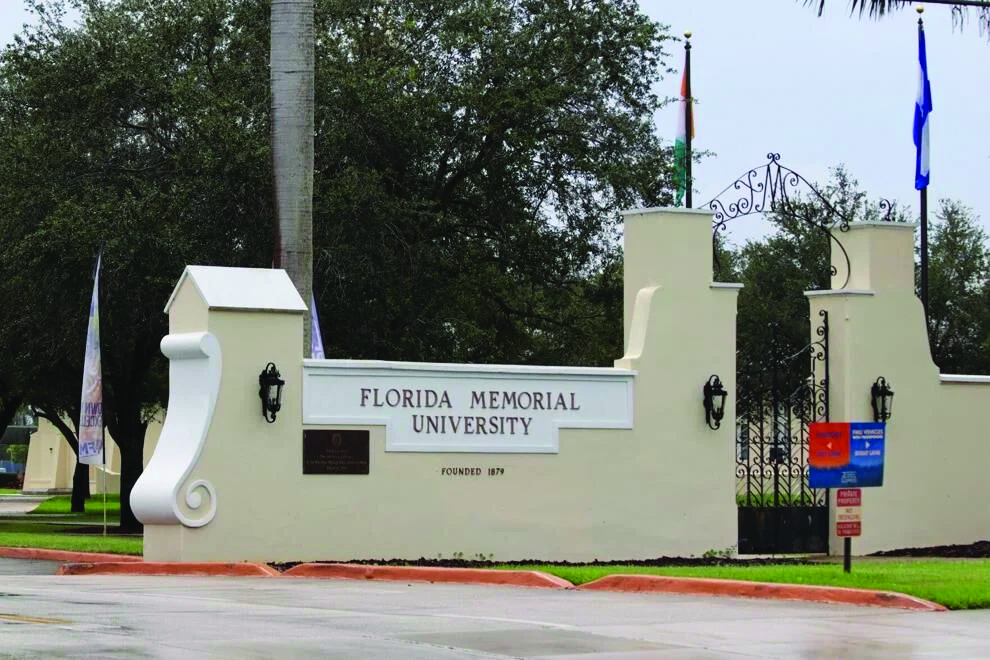
Not quite within that category — yet still at risk, Ye says — is Florida Memorial University, South Florida’s only private historically Black college, located in Miami Gardens.
In December 2025, the Southern Association of Colleges and Schools Commission on Colleges (SACSCOC) placed FMU on accreditation probation due to failure to meet standards relating to financial health. The next review is set for December 2026.

(Courtesy of Dan Ye)
The school has found itself within the “distressed” category on Ye’s list, placing 122nd out of 1,375 schools ranked for financial risk. The schools at the top of the list — those with the highest scores — showed the most “stress” or “collapse signals,” whereas schools with a 0 score — located at the bottom of the list — were deemed stable and healthy. FMU has a score of 62.3.
“I would not send my kids there because — unless they’re significantly revamping how they’re run and their recruitment strategies, and more importantly, their curriculum — I don’t see them lasting for another 10 years,” Ye said.
(Courtesy of Dan Ye)
Florida Memorial University did not respond to repeated requests for comment on this story.
Open School Ranking
Ye said the inspiration for his list came from his friends who inadvertently sent their daughter to a walking zombie college.
“As parents, you’re always judging what is a good school to send to your kid, and one of my friends sent his daughter to a school that recently closed, and it was pretty financially disastrous for them,” Ye said.
“You spend your whole life saving for your kid’s college tuition, and at her junior year at the school, suddenly (they) come out from nowhere saying, ‘Nope, sorry, ain’t gonna happen anymore,’” Ye said.
Ye said he compiled data and analyzed schools based on their likelihood to fail, so that parents can have an “early warning system” when deciding where to send their kids to school. He said the term “walking zombie” came from a similar term in business, where “a company whose gross profit is lower than the money used to service debt” is called a “walking zombie company.”
He said there are 29 schools with that category — schools he predicts will be closing in the next five years, if not sooner.
Ye said his rankings are based on enrollment figures and admission rates over a ten-year span.
“For a school, if they lose more than 40% of their student population compared to 10 years ago, that would be a really bad sign,” he said.
He also said that if a school’s admission rate is 90 percent or above, “it shows desperation, basically.”
“If you look at the walking zombie ranking, almost all of them have an acceptance rate of 80 or above, and some of them are like 99 percent to 100 percent. So that’s like a sign that they’re about to go under,” Ye said.
FMU deemed ‘distressed’
Ye pointed out FMU’s acceptance rate as an indicator of its financial distress.
“Their acceptance rate has increased significantly over the last 10 years,” Ye said. “Meaning that in order to keep its existing population, they’re continuously lowering its admission standard. Their acceptance rate was in the 20s, or low 30s, 10 years ago, and now it’s 85 percent. So that’s actually a very bad sign, showing that they are not capable of recruiting the same caliber of student they did 10 years ago, and that translates into a shrinking student population.”
But there might be some good news for FMU.
“Relatively speaking, Florida Memorial University’s numbers are a little healthier compared to other Florida universities on the distressed list. Their student body already shrank 15% in the last 10 years, compared to Barry University, which shrank 40%. But shrinking is shrinking, right?”
A surprise closing
Asked if there were any surprises in his research, he pointed out the prestigious Hampshire College.
“It’s a pretty well-known school in the education circle, and we know that a lot of liberal arts colleges are struggling, but just out of nowhere, Hampshire College says, ‘We’re closing, we can’t do this anymore,’” Ye said. “I understand the leadership definitely wants to keep their financial pressure sort of private in order not to affect recruitment. But for parents who are choosing these kind of schools, we really should know if schools like Hampshire College can even close out of the blue. That’s why I thought it’s really worth it to analyze every single school.”
He said schools about to close have two options.
“You can either do this the responsible way or the irresponsible way,” Ye said. “The responsible way is to give the kids plenty of leeway time, help them transfer their credits over to other schools and make the process relatively smooth.”
But not all schools take that path.
“But then the irresponsible way, which a lot of universities resort to, is basically just shut the door and say, ‘We’re really, really sorry. All the resources are now being used to pay back debts. We’re firing everybody effective yesterday.’”
He called either outcome “financially devastating for the family and ruinous for the students.”
Admissions office a recruiting agency
Ye said it’s important for parents and students to do their research. He said an admissions office is basically a recruiting agency.
“They can charm you, but behind all that marketing lies the reality of whether this school is expanding or is shrinking, and if the school’s enrollment has been declining considerably, I would recommend parents to avoid those schools — not just in the walking zombie state, but in the distressed category,” Ye said.
Ye said shrinking enrollment is due in part to a declining college-age population, as well as fewer international students due to the Trump administration’s new immigration policies.
“We are looking at a shrinking pie, and a lot of schools are going under very quickly, so it’s definitely something to keep in mind for parents because we are in a contraction state for the higher education industry,” he said.
