
 Civil Rights Icons, known as the Friendship 9, are set to have their convictions vacated, 53 years later
Thanks to local South Carolina author’s influence by Dr. Martin Luther King Jr. and The King Center
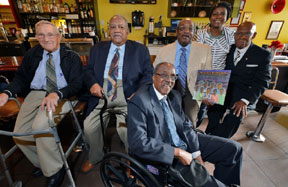
From l to r: David Boone, Clarence Graham, Willie McCleod, Kimberly P. Johnson (Author), and William “Dub” Massey. Front: James Wells. (Photo credit: T. Ortega Gaines-The Charlotte Observer)
Atlanta GA. — Surviving members of the “Friendship 9,” a group of students who attended Friendship Junior College in Rock Hill, S.C., during the high tide of the modern Civil Rights Movement, were recently notified by their lawyer that his intentions are to file a motion in South Carolina’s 16th Circuit Court to vacate their trespassing conviction that resulted from their arrest on Jan. 31, 1961. The young activists were detained after they nonviolently protested the “separate but equal” legal precedent relative to public accommodations by sitting at an all-white lunch counter at McCrory’s Variety Store in Rock Hill’s downtown district.
As part of the “Friendship 9,” David Williamson, Jr., James Wells, Willie McCleod, W.T. “Dub” Massey, Clarence Henry Graham, John Gaines, Thomas Gaither, Mack Work-man and Robert McCullough were relentless in their fight for equality. Their activism in the state known for legendary statesmen and strict constructionists, particularly, John C. Calhoun and Strom Thurmond, helped implement the practice of “Jail, No Bail”—a strategy of civil disobedience that is as old as the Hebrew Scriptures that called for the accused to accept punishment based on principles.
Their rallying cry, “Jail, No Bail,” came from their deeply-held belief that they should not willfully bow to a corrupt system. Their tactic was crucial in shifting the financial burden of the civil rights movement from the oppressed to the oppressor. Though the sit-in movement started a year before in Greensboro, N.C., the “Friendship 9” were among the first students to refuse to pay bail after being sentenced to 30 days of hard labor.
In 2014, Kimberly Johnson, author of No Fear for Freedom: The Story of the Friendship 9, became in-volved with The Martin Luther King, Jr. Center for Nonviolent Social Change in Atlanta, GA. As part of her work with The King Center’s Nonviolence Opportunity Watch (N.O.W) Encounter, a Summer Experience, she was exposed to, and digested, Dr. King’s philosophy on unjust laws after reading his Letter from the Birmingham Jail.
Johnson brought evidence of the unjust laws used against the “Friendship 9” to the attention of 16th Circuit Solicitor Kevin Brackett. He agreed with Johnson and determined that Dr. King was correct when he said in 1965 that “the arc of the moral universe is long, but it bends toward justice.” Dr. Bernice A. King, the CEO of The King Center in Atlanta, GA, and youngest daughter of the Nobel Laureate and Mrs. Coretta Scott King, said of her father that “his teachings are still relevant forty-seven years after his assassination because they compel mankind to confront injustice wherever it exists.” King, a lawyer and an ordained minister continued: “There is no statute of limitations for remedying an injustice in the High Moral Court of History. Like my father, I believe that the eloquent poet, James Russell Lowell, was correct when he wrote that ‘Truth forever on the scaffold, wrong forever on the throne, yet that scaffold sways the future.’”
On Sunday, Jan. 11, 2015, Kim Johnson, along with some of the members of the “Friendship 9,” will be signing her book on the activists as part of The King Center’s 47th Holiday observance in honor of Martin Luther King Jr. She will be one of several authors, including Dr. Cornel West and members of the King family, to participate in the book signing in Atlanta.
